



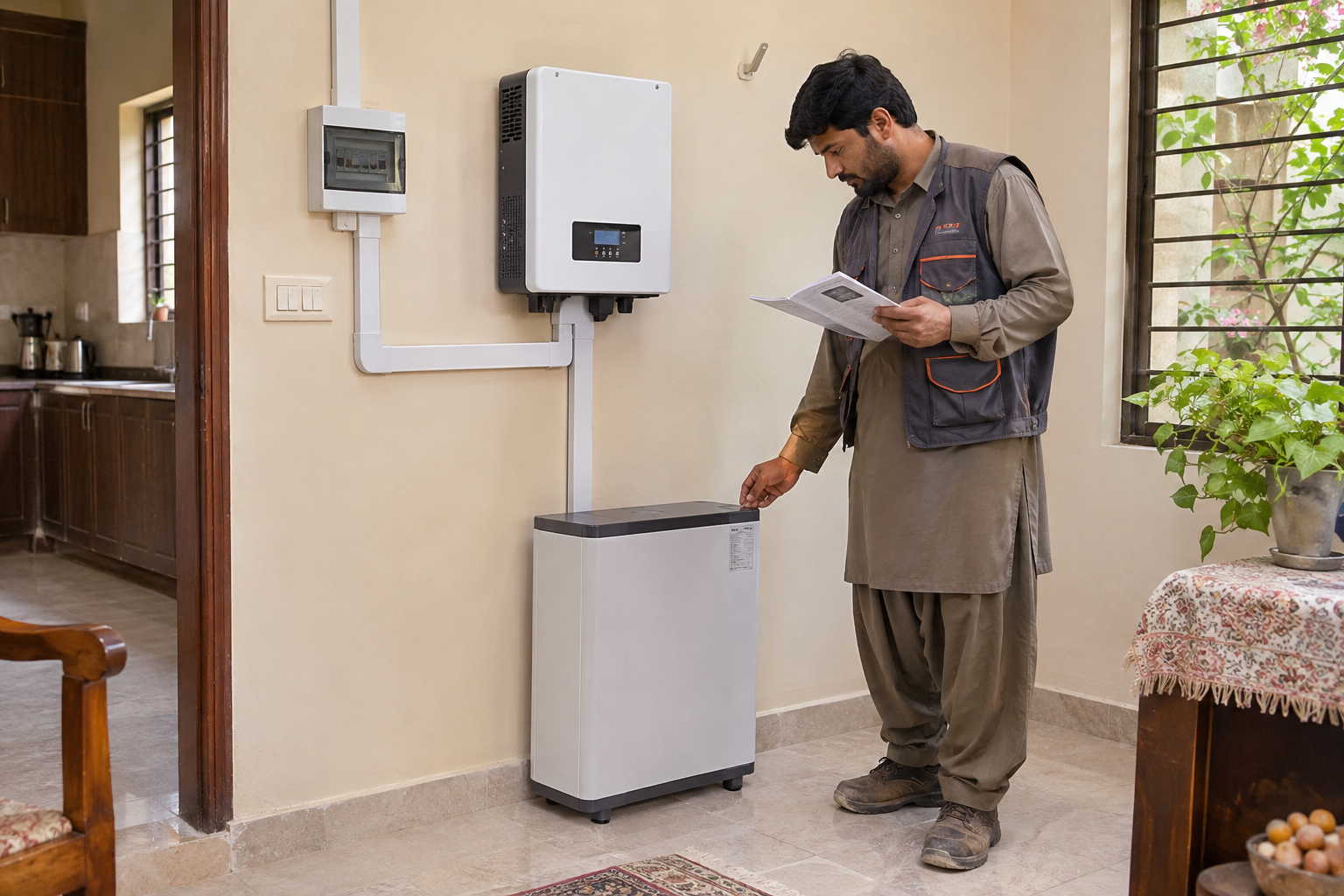
A lithium battery may have the right voltage on its label and still be a poor match for an inverter. Before connecting equipment, check the exact battery and inverter model manuals. Confirm voltage range, current limits, communication support and charging settings for that specific combination.
Safety note: This guide helps you check documentation; it is not wiring instructions. Have a qualified solar electrician install and configure the system. Follow both manufacturers’ instructions and local electrical requirements.
1. Match the battery bank voltage
“48V” is a system class, not a complete voltage specification. Many lithium solar batteries in this class are nominally 51.2V, and their operating and charging voltages vary. Check the battery’s nominal voltage and permitted operating range against the inverter’s supported battery range. Do not assume two products match because both are marketed as 48V.
For example, Dyness lists PowerHaus as 51.2V nominal with a 44.8–57.6V operating range. Use the current model manual to confirm what the inverter accepts; do not transfer those values to another battery.
2. Check BMS communication
The battery management system (BMS) monitors the battery and can share information such as state of charge, temperature, and charge/discharge limits. Check the battery and inverter compatibility lists for the exact models. Confirm whether they communicate over CAN or RS485, the required cable and port, protocol selection, and any DIP-switch or address settings.
A matching connector does not prove compatible communication. If the manuals do not list the combination, ask both manufacturers or an authorized technical representative before proceeding.
3. If communication is unavailable
Some systems allow a voltage-based or user-defined lithium profile, but the battery and inverter manuals must explicitly permit it. Obtain the battery maker’s recommended charge voltage, float behavior (if applicable), low-voltage cutoff, maximum charge/discharge current, and temperature limits. Set only values approved for the exact model. Never copy another brand’s settings from a forum or generic video.
4. Compare current and power limits
Check continuous and peak discharge current on the battery, and maximum battery charge/discharge current on the inverter. The usable system is constrained by the lower applicable limit. Also confirm that the battery can support the inverter’s load and surge requirements. Do not size from kWh alone.
5. Use this manual checklist
- Exact model and hardware revision for battery and inverter
- Nominal voltage and operating/charging voltage ranges
- Battery continuous and peak current limits
- Inverter maximum battery charge and discharge current
- Approved CAN/RS485 protocol, cable, port and communication settings
- Permitted non-communicating setup, if supported
- Warranty conditions and required installation/configuration
What to send the installer
Share clear photos of each product label, the inverter model/revision, battery model/revision, and the relevant manual pages. Ask the installer to confirm the exact pairing in writing before purchase or connection. Browse ExpoSolar’s lithium batteries and hybrid inverters, or ask the team to verify a model pairing.
Example from manufacturer documentation
Dyness specifies PowerHaus as a 51.2V, 100Ah, 5.12kWh LiFePO₄ battery, with CAN/RS485 communication and a stated operating range of 44.8–57.6V. This is an example only; compatibility still depends on the inverter model, protocol and current approved compatibility information. See the Dyness residential energy solutions brochure.
Frequently asked questions
Can any 48V lithium battery work with any 48V inverter?
No. Voltage class alone does not establish acceptable voltage range, current capability, BMS protocol or warranty-approved compatibility.
Can I use a lithium battery without CAN communication?
Only if the battery and inverter manufacturers permit that operating mode and provide the required manual settings. Have a qualified installer verify this.
Can I set the battery voltage myself?
Use only model-specific manufacturer instructions and a qualified installer. Incorrect values can cause shutdowns, poor operation or equipment damage.

Comments are closed