



Updated: November 2026. The 7 kVA, Novatek and Infinix prices in this guide are EXPO Solar’s current stock prices, checked in November 2026. The wider brand bands are planning ranges from 2026 market guides: inverter prices move with the dollar, with stock, and with whether the unit has a local warranty. So confirm the day rate before you pay.
Walk into any solar shop in Lahore and ask for the solar inverter price in Pakistan. The dealer will not give you a number. He will ask you three questions back: on-grid or hybrid, single-phase or three-phase, and how many kilowatts? On-grid means grid-only. Hybrid means grid plus battery. Single-phase is a normal home supply. Three-phase is a stronger supply for bigger homes. He is not dodging you. An inverter is not one product with one price. It is a family of boxes. The box that fits a 5-marla house on a single-phase connection is a different machine, at a very different price, from the one a three-phase 1-kanal house needs.
This guide gives you the 2026 price bands for the brands you will actually meet: Huawei, Growatt, Solis, GoodWe, Inverex, Deye, and the value brands Crown and Knox. It also explains what pushes a quote to the top or the bottom of each band. Every figure here is a planning range from 2026 market guides and dealer listings. It is not a quotation. Prices move with the dollar, with stock, and with whether the unit has a local warranty. Confirm the day rate before you pay. And be careful with any quote far below the band.
7 kVA, Novatek and Infinix: The Inverters Pakistan Is Searching For
Before the brand bands, here is what people in Pakistan are actually typing into Google right now. Your neighbours included. In the last 28 days, the inverter searches bringing visitors to EXPO Solar were: “7 kva inverter price in pakistan”, “novatek inverter 6kw price in pakistan”, “infinix solar inverter 6kw price in pakistan”, and “infinix inverter 6kw price in pakistan”. None of those had a post of its own answering them. Until this one. These are the models behind those searches, with our November 2026 stock prices:
| Model | Type | Price (Nov 2026) | Best for |
|---|---|---|---|
| Ziewnic 7KVA Hybrid Inverter Z6 European | 7 kVA hybrid | Rs. 145,000 | The 7 kVA inverter price in Pakistan buyers ask for — medium-large homes, single-phase, battery-ready |
| Novatek Cortex Dual PV 7000 Plus 6kW Hybrid | 6 kW hybrid | Rs. 140,000 | The most-searched Novatek inverter — dual PV input, 6 kW hybrid for a standard home |
| Infinix Empire Hybrid 6kW V3 | 6 kW hybrid | Rs. 135,000 | The Infinix solar inverter 6kW price in Pakistan buyers search for — value 6 kW hybrid |
| Suntronics Power 6kW Hybrid Inverter PV7000+ | 6 kW hybrid | Rs. 150,000 | Our 6 kW hybrid pairing for lithium batteries — pairs with the Dyness 5.12kWh and Suntronics 16kWh battery |
| Infinix Hybrid 3.6kW Inverter | 3.6 kW hybrid | Rs. 75,000 | Smaller homes and light backup — the cheapest hybrid entry point in our stock |
| Infinix Blaze Gold Hybrid 3kW Inverter | 3 kW hybrid | Rs. 80,000 | Small-home hybrid with backup for fans, lights and fridge |
Two things stand out. First, the 6 kW hybrid is the size most medium Lahore homes end up with. The value brands sit close together on price: Infinix at Rs. 135,000, Novatek at Rs. 140,000, Ziewnic’s 7 kVA at Rs. 145,000, and Suntronics at Rs. 150,000. The difference between them is not kilowatts. It is monitoring, build quality, and who answers the phone when something fails. Second, a 7 kVA hybrid at Rs. 145,000 costs less than the published 6 kW hybrid bands from the big brands (Rs. 200,000–320,000). That is why the “7 kva inverter price in pakistan” search keeps growing. Buyers have found that a value-brand 7 kVA costs less than a premium-brand 6 kW. That is a real saving, not a trick. But only if the warranty is real and the battery list is checked first (see the checks section below).
Prices move with the dollar and with each shipment, so treat these as November 2026 stock prices. WhatsApp EXPO Solar on +92 300 4768050 for today’s exact price on any model above and a free quotation.
Solar Inverter Price in Pakistan by Size
Start with on-grid inverters, the simpler kind. They turn panel power into power for daytime use and export. And they stop during a grid outage. That last point is a safety rule, not a fault. It is the main reason a buyer who wants backup during load shedding needs a hybrid instead.
| On-grid inverter | Typical 2026 price band |
|---|---|
| 3 kW, single-phase | Rs 80,000 – 155,000 |
| 5 kW, single-phase | Rs 130,000 – 220,000 |
| 10 kW, three-phase | Rs 245,000 – 400,000 |
| 15 kW, three-phase | Rs 355,000 – 545,000 |
The price range inside each row is mostly down to brand. At 5 kW, published 2026 guides put Growatt around Rs 130,000 to Rs 170,000, and Solis around Rs 140,000 to Rs 175,000. Huawei sits around Rs 175,000 to Rs 220,000, and a European brand like Fronius costs more again. Same size. Same job on paper. Very different prices. The difference buys monitoring, build quality, and a service network — not extra kilowatts.
Hybrid inverters cost more because they do more. They manage a battery. They switch to backup power when the grid drops. And they decide, moment by moment, whether solar power should run the house, charge the battery, or export. That extra electronics and software is why they cost more.
| Hybrid inverter | Typical 2026 price band |
|---|---|
| 5 kW, single-phase | Rs 220,000 – 340,000 |
| 6 kW, single-phase | Rs 200,000 – 320,000 |
| 10 kW, single- or three-phase | Rs 260,000 – 550,000 |
| 15 kW, three-phase | Rs 550,000 – 700,000 (estimated from the 10 kW band) |
The 10 kW hybrid band is wide on purpose. Published guides really do disagree, and there is a reason for that. A single-phase 10 kW hybrid from a value brand sits near the bottom. A three-phase 10 kW hybrid with a high-voltage battery system sits near the top. Some Solis models, for example, are quoted at Rs 455,000 to Rs 550,000. Comparing those two figures as if they were the same product is the most common mistake buyers make. Ask for the phase, the battery voltage, and the model number. Then the band narrows fast.
Two examples with names help pin down the 6 kW hybrid market — the size most medium Lahore homes end up with. A Solis 6 kW single-phase hybrid was listed around Rs 228,000 to Rs 255,000 in 2026 guides. A Growatt 6 kW hybrid was listed around Rs 200,000 to Rs 280,000. And a Crown 6 kW value hybrid was listed around Rs 140,000 to Rs 163,000. An Inverex Nitrox 8 kW hybrid was listed around Rs 265,000. Those are not rankings. Crown wins on upfront price, Solis and Growatt on efficiency and app monitoring, and Inverex on local support. But they show why “a 6 kW hybrid” is not a price. The value-brand models in the section above (Infinix Rs 135,000, Novatek Rs 140,000, Ziewnic 7 kVA Rs 145,000) sit at or below the bottom of those bands. That is exactly why buyers search for them by name.
On-Grid, Hybrid, or Off-Grid: Pick the Type Before the Brand
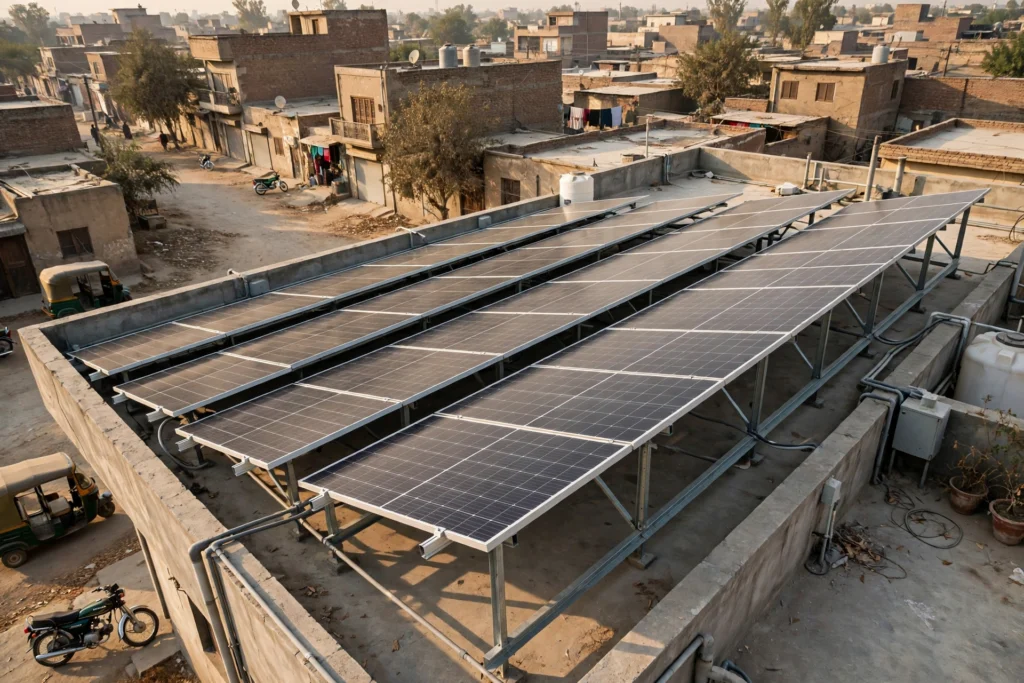
The type decision matters more than the brand decision. And it is hard to change later without spending a lot.
An on-grid inverter suits a home with stable grid supply where the goal is a lower bill. It has no battery connection, so it cannot keep lights on during an outage. A hybrid inverter suits a home that loses power, or that wants to store daytime solar for the evening. It works without a battery on day one, as an on-grid inverter, at a higher price. And it takes a battery later. That is a sensible route if the battery budget comes a year after the panels. An off-grid inverter, for homes with no reliable grid at all, is a separate purchase and a separate design. Most Lahore buyers do not need it. A dealer pushing off-grid equipment for a grid-connected house is solving the wrong problem.
Phase matters just as much. A house with a single-phase LESCO connection takes a single-phase inverter. A house with a three-phase connection needs a three-phase inverter. Three-phase connections are common in larger homes and in homes running three-phase motors. The other option is a single-phase inverter wired to one phase. That leaves the load unbalanced, which means the power is uneven across the phases. That is a compromise. Your installer should explain it plainly rather than quietly fit it. Check your bill and your meter before you accept a quote, not after the box is on the wall.
Our Huawei vs Growatt comparison covers the two brands Lahore buyers ask about most, and our sizing guide covers how system size follows your bill rather than your roof area.
What Actually Moves the Price
Four things explain almost all the difference between two quotes for the same kilowatt rating.
First, brand and warranty. Most recognised brands quote a 5-year standard warranty. Some Huawei models come with 10 years. And some dealers offer extensions for a fee. A warranty that is honoured in Lahore, by a dealer who answers the phone, is worth more than a longer warranty that makes you ship a faulty unit abroad. Ask who handles a fault. And ask how long a replacement takes in July, when every installer is busy and every inverter fault feels urgent.
Second, battery compatibility. This is the trap for buyers who plan to “add a battery later”. Some hybrids take open-standard low-voltage LiFePO4 batteries. LiFePO4 is the lithium battery type most home systems use. Pylontech, Dyness, and similar brands make them, which gives you choice and competitive battery prices later. Others take only their own high-voltage battery, which locks you into one brand’s battery price. Neither design is wrong, but buying the closed system without knowing it is. Check the battery list in the inverter’s datasheet before you buy the inverter, not when the battery quote arrives. Our battery guide and our load-shedding guide cover which battery type and size suit which outage pattern — and our lithium batteries category shows the batteries we stock now.
Third, protection and placement ratings. An IP65 inverter can sit outdoors in rain and dust. IP65 means it is sealed against rain and dust. An IP21 inverter belongs indoors, in a room with air flow. IP21 means it is only protected against dripping water. Lahore’s summer heat and winter dust punish indoor-rated boxes fitted on an outside wall. They also punish any inverter fitted in a sealed store room with no air flow. The rating is printed on the datasheet. If your installer suggests an indoor unit for an outdoor spot to save money, that saving will cost you the inverter.
Fourth, genuine versus grey stock. The same model number can come from two places. One is an official dealer, with warranty registration and commissioning support. Commissioning means the dealer sets the inverter up and checks that it works. The other is a grey importer, an unofficial seller, who charges less but gives no dealer-honoured warranty. Published guides say this plainly: the bottom of a price band is often grey stock. Get the serial number. Register the warranty yourself. And check that the unit’s firmware — its built-in software — and app work on your phone before the installer leaves. A cheap inverter with no warranty is the most expensive inverter you can buy. Because it is the one you buy twice.
Net Billing Changes the Maths, Not Just the Bill
Since February 2026, new solar consumers fall under net billing rather than the old net metering rules. Under net billing, the grid pays you a low price for the power you export, while you pay the full retail price for the power you import. New agreements run five years rather than seven. The exact export figure varies by source and by DISCO. Published 2026 guides quote roughly Rs 8 to Rs 13 per unit. So this guide does not base its advice on a single rate. But the direction is the same in every guide. A unit your own home uses during the day is worth far more than a unit you export.
That changes inverter choice in a practical way. Under the old rules, a cheap on-grid inverter and a large array made sense, because exports wiped out night usage almost unit for unit. Under net billing, a hybrid inverter with a battery, sized so daytime solar covers daytime load and the battery covers the evening peak, protects more of your money — which is why hybrid demand, and hybrid prices, have held up even as panel prices fell. Our net billing explainer covers the rule change in full, and our panel price update tracks the panel side of the same picture.
It also changes how you read a payback promise. If a quote’s payback assumes exports cancel imports unit for unit, it is using the old rules. Ask for the payback with exports valued at the low price the grid pays you for exported power, and imports at your actual slab rate. If the installer cannot show you that calculation, the payback is a guess, not a figure.
Checks Before You Pay
Run through this list before you sign anything. Not after the boxes are on your wall. Ten minutes now can save you a second purchase later.
- Brand, model, phase, and type in writing. “10 kW inverter” on a quote does not say enough. Get the model number.
- Battery compatibility in writing. Which batteries does this exact model accept, and at what voltage?
- Warranty terms and local service. Who handles a fault, where, and how fast — in writing, with a phone number that answers.
- Serial number and registration. Check the serial with the brand or dealer, and register the warranty yourself.
- MPPT count and panel string match. Two MPPT trackers, the parts that get the most power out of your panels, handle two roof directions better than one. Check the string voltage and current against the inverter’s limits, not just the panel wattage.
- Placement and rating. IP rating against the actual spot on your wall, with air flow and shade in summer.
- Monitoring that works. Open the app on your own phone, on site, before final payment. An inverter you cannot monitor is an inverter you cannot check.
- Cleaning and heat. Lahore dust and smog cut panel output if panels are left dirty, and heat makes the inverter work less well if the box sits in direct sun. Our cleaning guide covers the routine.
And get two or three quotes for the same details. Same inverter model, same panel, same battery plan. Comparing a Growatt on-grid quote against a Huawei hybrid quote tells you nothing. Comparing three quotes for the same hybrid model tells you who is adding extra cost and who is cutting the warranty.
Frequently Asked Questions (FAQ)
What is the 7 kVA inverter price in Pakistan in 2026?
A 7 kVA hybrid inverter in Pakistan in 2026 costs around Rs. 145,000 for a value brand — for example the Ziewnic 7KVA Hybrid Inverter Z6 (Rs. 145,000, EXPO Solar November 2026 stock price). Premium-brand 7 kVA hybrids cost more; the wider 6–8 kW hybrid band in published guides runs roughly Rs. 140,000 to Rs. 320,000 depending on brand, phase and battery voltage.
What is the Novatek inverter 6kW price in Pakistan?
The Novatek Cortex Dual PV 7000 Plus 6kW Hybrid costs Rs. 140,000 (EXPO Solar November 2026 stock price). It is the Novatek model Pakistani buyers search for most, with dual PV input for two roof directions.
What is the Infinix solar inverter 6kW price in Pakistan?
The Infinix Empire Hybrid 6kW V3 costs Rs. 135,000 (EXPO Solar November 2026 stock price). Smaller Infinix hybrids cost less: the 3.6kW is Rs. 75,000 and the Blaze Gold 3kW is Rs. 80,000.
Hybrid or on-grid inverter — which one do I need in Pakistan?
A hybrid if you face load shedding or want a battery later — it keeps power on during outages and stores daytime solar for the evening, which matters more under net billing. An on-grid inverter only if your grid supply is stable and you only want a lower bill, since it stops during an outage. See the type section above for the full comparison.
What size inverter do I need for a 10-marla home in Lahore?
Most 10-marla homes land on a 5–6 kW hybrid (or a 7 kVA hybrid like the Ziewnic Z6) — enough for fans, lights, fridge, TV and a 1.5-ton inverter AC with a battery for the evening. The exact size follows your bill, not your roof: our sizing guide works it out from your units, and if the upfront cost is the barrier, solar panel financing spreads it.
The Bottom Line
For most Lahore homes in late 2026, the planning figures are these. A 5 kW on-grid inverter from about Rs 130,000. A 5 kW hybrid from about Rs 220,000. A 10 kW on-grid three-phase inverter from about Rs 245,000. And a 10 kW hybrid from about Rs 260,000 at the value end to about Rs 550,000 for a three-phase, high-voltage-battery model. Brand, warranty, battery lock-in — being tied to one brand’s batteries — and grey stock versus stock from an official dealer explain the gaps. Not the kilowatt rating alone. And the models buyers are actually searching for by name sit at the value end of those bands, with real stock behind them: Ziewnic 7 kVA (Rs 145,000), Novatek 6 kW (Rs 140,000), and Infinix 6 kW (Rs 135,000).
Pick the type first, the phase second, and the brand third. Then check the serial, the warranty, and the battery list. Pay for the inverter that will still be serviced in five years, not just the one that is cheapest this week.
Get a Free Quotation on Your Inverter
Ready to price the exact inverter for your home? WhatsApp EXPO Solar on +92 300 4768050 or call the same number for a free quotation — tell us your connection type, your daytime load and your outage pattern, and we will price the inverter, and the battery it can actually take, for your home. We serve Lahore, Islamabad, Karachi, and Okara.
3.6kW hybrid inverter options
For buyers comparing a 3.6kW hybrid inverter, ExpoSolar lists the Crown Xavier 3.6kW and Infinix Hybrid 3.6kW. Confirm the exact model variant before comparing specifications: battery voltage, PV input limits, MPPT current, phase, supported battery chemistry and warranty can differ by version. Request a current price and datasheet for the exact unit.
When asking for a quote, send your city, electricity connection phase, approximate daytime load, battery requirement and preferred model. Ask for stock status, warranty terms, delivery and installation as separate quote items.
Browse hybrid inverters or request a current equipment price.

CM Solar Panel Scheme Phase 2: 100,000 Free Panels Punjab
November 23, 2026 6:59 am[…] you decide, it helps to know the current prices. Read our guide on solar inverter prices in Pakistan to see what an inverter costs today. And if you want power during load-shedding, compare your […]