



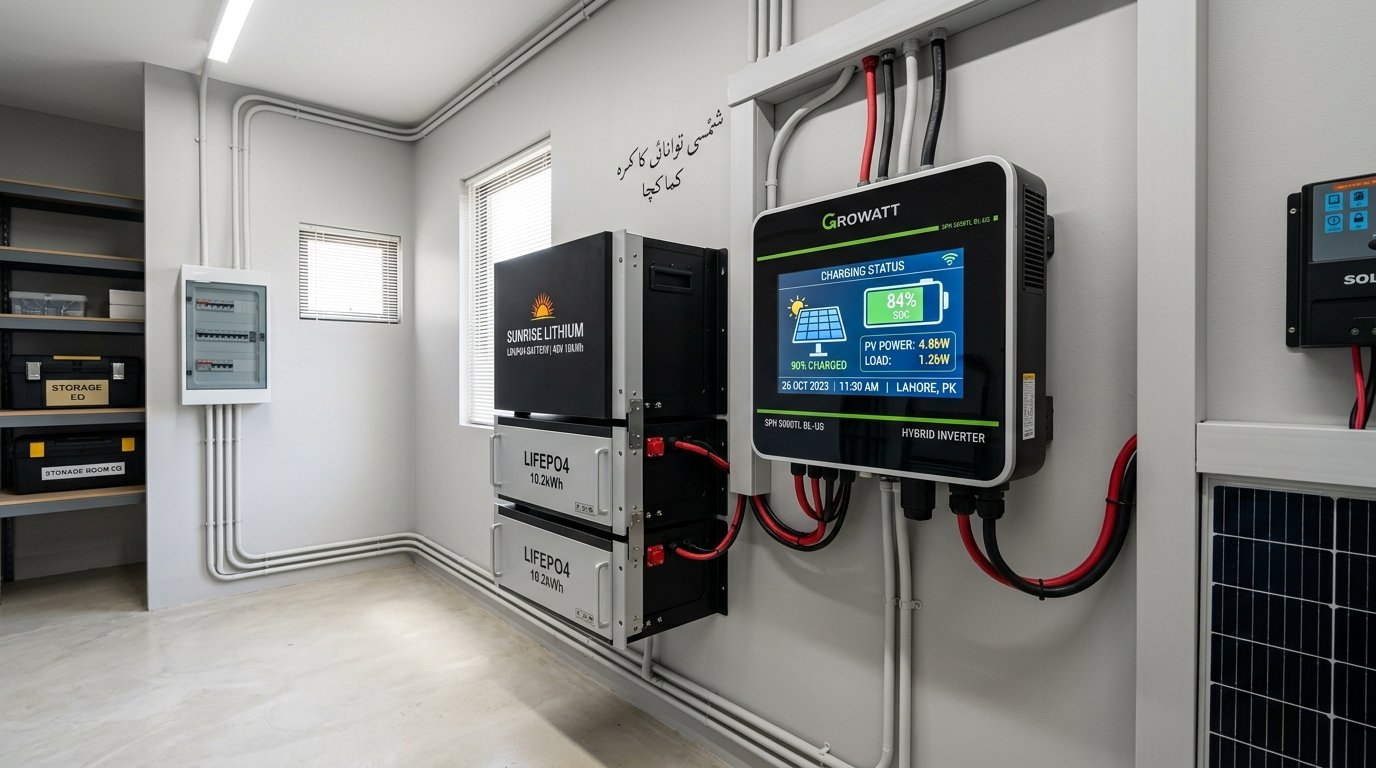
Updated: November 2026 — battery models and prices in our current stock were checked against EXPO Solar’s shop in November 2026. General price bands in this guide are planning ranges: battery prices move with the dollar and stock, so WhatsApp us for today’s exact price before you buy.
Quick comparison: The right solar battery depends on your evening load, inverter compatibility, usable capacity, warranty terms and budget. LiFePO₄ batteries usually offer more usable energy in a compact package, while tubular lead-acid batteries often cost less upfront and require periodic maintenance. Compare the specifications and written warranty for the exact model before deciding. Prices and availability change; ask ExpoSolar for a current quote.
With grid electricity tariffs exceeding Rs. 65–75 per peak unit and NEPRA transitioning from Net Metering to Net Billing in 2026, choosing the best solar battery Pakistan has to offer is no longer just about surviving load shedding. It is now the single most important factor determining your monthly electricity bill savings.
When DISCOs buy back your daytime surplus solar energy at only Rs. 14–16 per unit but charge you Rs. 60+ to draw power at night, storing your solar energy for evening self-consumption beats exporting it to the grid every single day. But should you invest in modern Lithium (LiFePO4) batteries or stick with traditional Tubular Lead-Acid batteries? Let’s break down the real numbers for the Pakistan market.
1. Lithium vs Lead-Acid Battery Comparison: Complete Specs & Cost in Pakistan
Here is an objective, head-to-head comparison of the two contenders for the best solar battery Pakistan has in 2026: Lithium Iron Phosphate (LiFePO4) wall-mounted batteries and deep-cycle Tall Tubular lead-acid batteries.
| Feature / Metric | Lithium (LiFePO4) Battery | Tall Tubular Lead-Acid Battery |
|---|---|---|
| Initial Upfront Cost (5 kWh capacity) | Rs. 280,000 – Rs. 360,000 | Rs. 130,000 – Rs. 160,000 (4 × 12V 200Ah) |
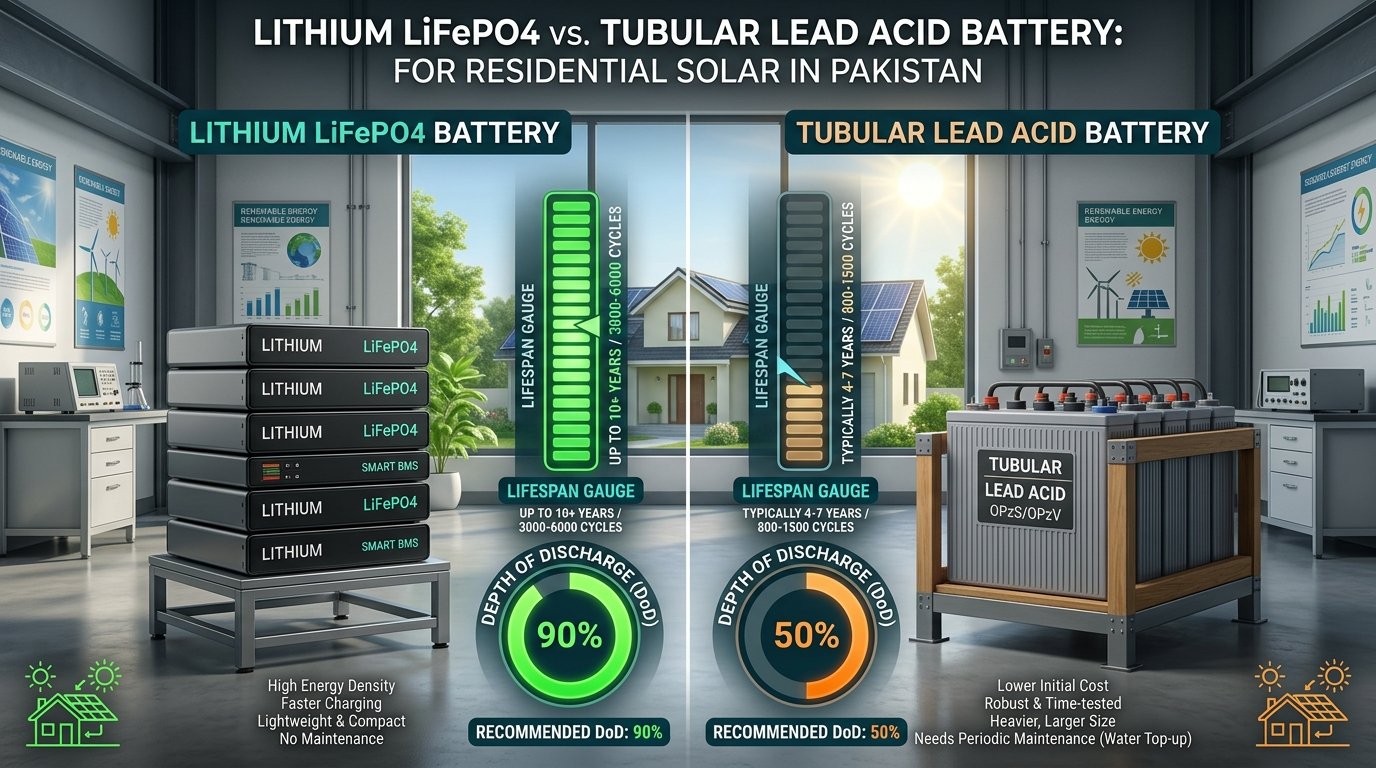
| Cycle Life (to 80% capacity) | 4,000 – 6,000 cycles | 1,000 – 1,500 cycles |
| Expected Lifespan | 10 to 15 Years | 3 to 4 Years |
| Usable Depth of Discharge (DoD) | 90% – 95% | 50% (Max safe discharge) |
| Round-Trip Efficiency | 95% – 98% | 75% – 80% (20%+ lost as heat) |
| Maintenance Required | Zero maintenance (Smart BMS) | Monthly distilled water top-up + acid check |
| Space & Weight | Compact, wall-mounted (~45–55 kg) | Bulky rack, heavy (~240–280 kg total) |
| Hazardous Fumes & Odors | Zero emission (Safe for indoor installation) | Emits hydrogen gas & acid fumes during charging |
| Warranty in Pakistan | 5 to 10 Years standard | 1 to 2 Years |
| 10-Year Total Replacements | 0 replacements needed | 2 to 3 full bank replacements |
| 10-Year Total Cost of Ownership | Rs. 320,000 (Lower) | Rs. 480,000 – 550,000 (Higher) |
Battery prices move with the dollar and stock, so treat the bands above as planning ranges. For today’s exact price on any battery in this guide, WhatsApp EXPO Solar on +92 300 4768050 for a free quotation.
2. Why Solar Batteries Matter More in 2026 (The Net Billing Revolution)
Under Pakistan’s previous 1:1 net metering framework, the national electrical grid acted as a free virtual battery. You could export 1 unit during the blazing afternoon and withdraw 1 unit at night with zero loss. That era has officially ended.
Under NEPRA’s revised Net Billing Prosumer Regulations (read our detailed breakdown on Net Metering to Net Billing in Pakistan):
- Export Buyback Rate: DISCOs (LESCO, K-Electric, IESCO) credit your daytime surplus at the national average power purchase price (approx. Rs. 14.50 – 16.50/unit).
- Import Peak Tariff: When you draw power between 6:00 PM and 11:00 PM to run inverter ACs, fans, and refrigeration, you are billed at peak consumer rates (Rs. 62.00 to Rs. 78.00/unit including fuel adjustment charges and taxes).
- The Financial Gap: For every kilowatt-hour you export and buy back, you lose Rs. 48 to Rs. 60 per unit in tariff spread.
By routing daytime solar generation into a high-efficiency Lithium LiFePO4 battery bank, you avoid purchasing expensive peak grid power completely, accelerating your overall solar system ROI.
3. Lithium (LiFePO4) Solar Batteries: Pros, Cons & Best Brands in Pakistan
Lithium Iron Phosphate (LiFePO4) chemistry is specifically tailored for Pakistan’s harsh environmental conditions, which is why it is the best solar battery Pakistan homeowners can rely on: it possesses high thermal stability and cannot enter thermal runaway (unlike older Lithium-Cobalt phone batteries).
Top Advantages of Lithium Batteries:
- 90%+ Usable Energy: A 10 kWh lithium pack delivers 9.0–9.5 kWh of actual usable energy without damaging the cell structure.
- Rapid Charging: Lithium accepts high charge currents (0.5C to 1C), recharging from 0% to 100% in just 2 to 2.5 hours of bright sunlight.
- Integrated Smart BMS: Built-in Battery Management System (BMS) communicates directly with hybrid inverters (via CAN/RS485) to protect against over-discharge, high ambient temperature, and cell imbalance.
That BMS communication is also why the inverter matters when you choose the best solar battery Pakistan homes are installing today: a lithium battery only delivers its full life when the hybrid inverter talks to it properly. If you are still choosing the inverter, our Huawei vs Growatt comparison works through the two brands Lahore buyers ask about most.
- Zero Daily Maintenance: No water topping, no corrosive terminal cleaning, and completely sealed for indoor bedroom or garage installation.
Leading Lithium Battery Brands in Pakistan:
- Huawei LUNA2000 (5kWh – 15kWh modular): The gold standard in residential energy storage with 100% DoD and 10-year warranty.
- Narada 48V 100Ah / 200Ah Lithium: Highly popular, reliable telecommunication-grade LiFePO4 cells offering 5,000+ cycles.
- Pylontech US3000C / US5000: Globally certified, modular rack-mount batteries compatible with Growatt, Deye, and Voltronic inverters.
- Inverex Power Wall & LiFePO4: Locally distributed with authorized service centers across Lahore, Karachi, and Islamabad.
- Felicity Solar / Dyness: Cost-effective wall-mounted solutions offering high-density storage for 5kW–10kW systems.
Lithium battery models listed by ExpoSolar
The products below are listed in the ExpoSolar catalogue. Listing does not confirm current stock or price; contact the team to verify availability, model details and warranty terms before ordering.
| Model | Capacity | Price (Nov 2026) | Best for |
|---|---|---|---|
| Suntronics Power 16kWh Lithium Battery | 16 kWh, 51.2V LiFePO4 | Rs. 610,000 | Whole-home backup, 1.5-ton AC nights, 10 kW systems |
| Dyness PowerHaus 5.12kWh Lithium Battery | 5.12 kWh, 51.2V, IP66 | Price on request | 5 kW hybrid systems, outdoor-rated installs |
| Dyness DL5.0C Pro 5.12kWh Lithium Battery | 5.12 kWh, 51.2V | Price on request | 5 kW hybrid systems, stackable expansion later |
| APEX 1300 LiFePO4 Battery | 1.3 kWh, 12.8V 102Ah, IP65 | Rs. 60,000 | Small backup, single-room load, starter lithium |
The Suntronics 16kWh is our most-viewed battery — the best solar battery Pakistan homeowners ask us about for whole-home backup — and it pairs with a 10 kW hybrid system and covers the full evening load in the sizing example further below. The Dyness 5.12kWh models are the right size for a standard 5 kW home hybrid setup and can be stacked later if your load grows. The APEX 1300 is a small, weatherproof lithium unit for light backup rather than whole-home storage. For today’s price on the Dyness models, WhatsApp us on +92 300 4768050 — Dyness prices move with each shipment, so we quote the day rate.
Choosing a battery for a home inverter in Pakistan
Start with the loads you want to run and for how long. Then check the battery voltage, usable capacity, inverter support and written warranty for the exact model. There is no single best battery for every home.
Three things decide it:
- Capacity against your load. Add up what runs after sunset (the sizing section works this out: about 7.7 kWh for a typical 10-marla home). A battery that is too small will cut out before morning; a battery far too big wastes money. For fans, lights, TV, fridge and Wi-Fi only, a single Dyness PowerHaus 5.12kWh is usually enough. Add a 1.5-ton inverter AC and you need 10 kWh or more — the Suntronics Power 16kWh covers it with room to spare.
- Depth of discharge. A tubular battery rated 10 kWh only gives you 5 kWh safely. A 5.12 kWh lithium battery gives you about 4.6–4.9 kWh. So a smaller lithium pack often replaces a much bigger tubular bank — check the usable kilowatt-hours, not the headline number.
- The inverter it pairs with. A lithium battery needs a hybrid inverter that speaks its BMS language (CAN/RS485). Our most common pairing is a 5.12 kWh Dyness with a 6 kW hybrid inverter such as the Suntronics Power 6kW Hybrid Inverter PV7000+ (Rs. 150,000). If your current inverter is an old UPS-type unit with no lithium setting, it will not charge a lithium battery correctly — that is the point at which the inverter, not the battery, needs replacing. Our load-shedding guide covers which setup suits which outage pattern.
4. Tubular Lead-Acid Batteries: Are They Still Worth It?
Tall Tubular batteries (like Phoenix TX-1800/2500, AGS, Osaka, and Daewoo) utilize thick lead oxide plates encased in woven tubes. While they are significantly better than standard automotive car batteries, they have critical limitations in a 2026 solar setup:
- The 50% DoD Constraint: If you buy a bank rated for 10 kWh, you can only safely discharge 5 kWh. Discharging deeper than 50% permanently damages the lead plates and voids your warranty.
- High Internal Resistance & Heat Loss: Up to 20–25% of your expensive solar power is wasted as heat during charging.
- Maintenance Burden: In hot Pakistani summers (May–July), electrolyte evaporation requires regular distilled water refilling every 3 to 4 weeks.
- When They Still Make Sense: If your total budget is under Rs. 150,000 and you only need basic 2–3 hour backup for fans and LED lights during outages, a 2-battery or 4-battery tubular bank remains a viable entry-level option. And if the upfront cost of lithium is the only thing holding you back, look at how to pay for your solar system — spreading the cost often makes the battery with the lower 10-year cost affordable from day one.
5. How to Size Your Solar Battery Bank for Evening Loads
To calculate the exact battery capacity your home requires from sunset (6:30 PM) until bedtime (11:30 PM), use this engineering sizing formula:
Required Battery Capacity (kWh) = (Total Connected Watts × Operating Hours) ÷ (DoD × Inverter Efficiency)
Real-World Sizing Example (Typical Pakistani 10-Marla / 1-Kanal Home):
| Appliance | Wattage (Running) | Evening Hours | Total Daily Consumption |
|---|---|---|---|
| 1 × 1.5-Ton DC Inverter AC | 1,000 Watts (avg) | 5 Hours | 5.00 kWh |
| 4 × BLDC Energy Saver Fans | 40 Watts each = 160W | 6 Hours | 0.96 kWh |
| 10 × LED Lights | 12 Watts each = 120W | 6 Hours | 0.72 kWh |
| 1 × Inverter Refrigerator | 150 Watts | 6 Hours (50% duty) | 0.45 kWh |
| Wi-Fi Router + LED TV | 120 Watts | 5 Hours | 0.60 kWh |
| Total Evening Energy Requirement | – | – | 7.73 kWh |
- If Using Lithium LiFePO4 (90% DoD): You need
7.73 kWh ÷ 0.90 = 8.6 kWh. A standard 10 kWh 48V 200Ah Lithium Pack easily handles this entire night load with capacity to spare. A single Suntronics Power 16kWh battery covers this same load twice over, with capacity left for a second AC or a cloudy day. - If Using Tubular Lead-Acid (50% DoD): You need
7.73 kWh ÷ 0.50 = 15.5 kWhof raw battery capacity. That requires 8 heavy 12V 200Ah tubular batteries, taking up massive floor space and requiring periodic water maintenance.
Explore today’s live pricing on Tier-1 panels to charge your storage bank in our Solar Panel Price in Pakistan (Daily Live Rates) guide. For the full system sizing — panels, inverter and battery together — see how to size a solar system for a Lahore home.
6. Frequently Asked Questions (FAQ)
How much does a 5kWh lithium battery cost in Pakistan in 2026?
A high-quality 5kWh 48V 100Ah Lithium LiFePO4 battery (Narada, Pylontech, Inverex, Felicity) — the best solar battery Pakistan homeowners buy at this size — costs between Rs. 260,000 and Rs. 330,000 in Pakistan, depending on the brand, BMS features, and warranty duration.
Can I run a 1.5-ton AC on a solar lithium battery?
Yes. A 1.5-ton DC inverter AC consumes approximately 1.0 to 1.2 kW per hour once the room cools down. A 10kWh lithium battery bank can easily run your 1.5-ton AC for 7 to 9 continuous hours at night.
Can I mix lithium batteries with existing tubular batteries?
No, never mix different chemistries. Lithium and lead-acid batteries have fundamentally different charge voltages, internal resistances, and charging algorithms. Connecting them together will destroy the lead-acid cells and trigger BMS faults on the lithium pack.
How many years does a LiFePO4 battery actually last in Pakistan’s summer heat?
Under daily cycling (1 charge and 1 discharge per day = 365 cycles/year), a 6,000-cycle LiFePO4 battery lasts over 12 to 15 years before reaching 80% remaining capacity, even in ambient summer temperatures up to 45°C.
What is the best solar battery Pakistan has for a home inverter?
A 5.12 kWh lithium (LiFePO4) battery — such as the Dyness PowerHaus 5.12kWh — is the best solar battery Pakistan homes can pair with a standard home inverter setup running fans, lights, TV and fridge. It gives about 4.6–4.9 kWh of usable energy, charges in 2–2.5 hours of sunlight, and needs no maintenance. If you also run a 1.5-ton AC at night, step up to 10 kWh or more. See the ‘Best Battery for a Home Inverter in Pakistan’ section above for the full reasoning.
How much does a Dyness PowerHaus 5.12kWh cost in Pakistan?
Dyness prices move with each shipment, so we quote the day rate rather than a fixed figure. WhatsApp EXPO Solar on +92 300 4768050 for today’s Dyness PowerHaus price and a free quotation.
Which lithium batteries does EXPO Solar have in stock?
As of November 2026, our stock of the best solar battery Pakistan buyers ask for includes the Suntronics Power 16kWh (Rs. 610,000), the APEX 1300 1.3kWh (Rs. 60,000), and the Dyness range including the PowerHaus 5.12kWh and DL5.0C Pro 5.12kWh (price on request — WhatsApp for the day rate).
Get Custom Hybrid Battery Storage Sizing from EXPO Solar
Ready to upgrade your home to true energy independence and eliminate peak electricity bills? WhatsApp EXPO Solar on +92 300 4768050 or call the same number for a free quotation — tell us your evening load and we will size the battery, match the inverter, and price the full hybrid system for your home — built around the best solar battery Pakistan has for your evening load. We serve Lahore, Islamabad, Karachi, and Okara with Tier-1 LiFePO4 battery installations and customized energy audits.
Inverex 48V 100Ah battery: what to confirm
The ExpoSolar catalogue lists an Inverex 48V 100Ah lithium battery. Before purchase, confirm the exact nominal voltage and energy on its label, usable capacity, inverter compatibility and communication requirements, warranty coverage and current price. Contact ExpoSolar on WhatsApp for a model-specific quote.
Dyness PowerHaus 5.12kWh
The Dyness PowerHaus product listing identifies a 51.2V, 100Ah LiFePO₄ battery with 5.12kWh nominal energy and IP66 protection. Verify inverter compatibility and current stock with the team before ordering.

Solar Panel Price In Pakistan: October 2026 Guide
October 6, 2026 7:14 am[…] sized to your daytime load pays back years faster than an oversized one built for export. Our battery guide explains how storage fits into this […]
Solar Panel Financing In Pakistan: 2026 Bank Guide
October 9, 2026 5:19 am[…] amount. Worth it if outages hit your work or sleep; less so if your area has stable supply. Our battery comparison breaks down lithium vs lead-acid […]
Solar Inverter Price In Pakistan 2026: Brands & Sizes
November 17, 2026 4:35 pm[…] the inverter’s datasheet before you buy the inverter, not when the battery quote arrives. Our battery guide and our load-shedding guide cover which battery type and size suit which outage pattern — and our […]
CM Solar Panel Scheme Phase 2: 100,000 Free Panels Punjab
November 23, 2026 6:59 am[…] Before you decide, it helps to know the current prices. Read our guide on solar inverter prices in Pakistan to see what an inverter costs today. And if you want power during load-shedding, compare your options in our guide to the best solar battery in Pakistan. […]