



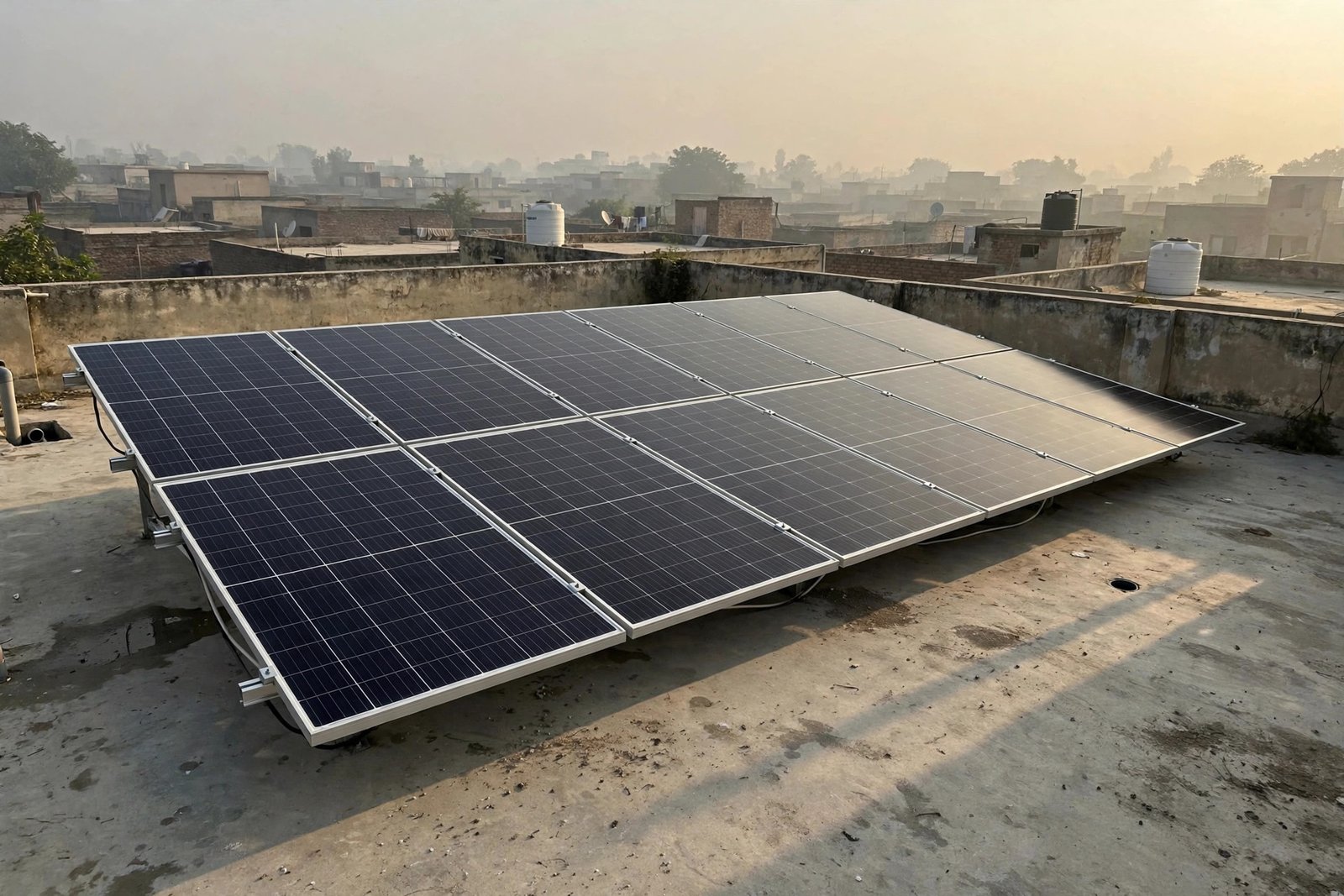
A decent 5kW home system in Lahore costs somewhere around Rs 850,000 to Rs 1 million today — panels, inverter, structure, wiring, installation, the whole thing. Most families do not have that kind of money sitting in a savings account. And yet the WAPDA bill keeps climbing, so waiting feels expensive too.
That is where solar panel financing in Pakistan comes in. Banks, Islamic financing windows, and two provincial governments now offer ways to put panels on your roof without paying everything upfront. The options are real, but the fine print matters a lot — interest rates float, down payments vary, and not every “easy installment” plan is actually easy.
Here is an honest, engineer-level look at what is available in October 2026: the bank products, what they actually cost per month, how to apply, the Islamic options, the government schemes, and the traps worth dodging.
Why Financing Solar Is Different From a Normal Loan
Almost every bank solar loan in Pakistan is priced off KIBOR — the Karachi Interbank Offered Rate. That means your markup floats. When KIBOR moves, your installment moves with it.
As of early October 2026, 1-year KIBOR sits around 12.7%. A bank quoting “1-year KIBOR + 3%” is therefore charging you roughly 15.7% per annum right now. If KIBOR rises next year, your monthly payment rises too. Before signing anything, ask the bank for the Key Fact Statement — it is the one document that shows the real rate, every fee, and what happens if rates change. Only one bank in Pakistan actually publishes its solar loan rate on its website. For the rest, the Key Fact Statement is your only honest window into the deal.
There is a second difference from a normal loan: the asset itself is the security. Banks typically take a hire-purchase or hypothecation charge on the panels and inverter, plus post-dated cheques. That keeps the paperwork lighter than a mortgage — no property mortgage is usually required for residential solar loans — but it also means the bank can repossess the system if you default. Treat the installments as seriously as rent.
Solar Panel Financing: Bank Options Compared (2026)
Six banks publish residential solar financing terms on their own pages. Here is how they stack up:
| Bank / Product | Amount | Tenor | Down Payment | Rate |
|---|---|---|---|---|
| Bank Alfalah Home Solar Finance | Up to Rs 5 million | 3–10 years | Not stated | 1Y KIBOR + 3% (salaried), + 4% (self-employed) |
| Meezan Bank Solar Financing (Islamic) | Rs 100,000 – 2.5 million | 1–5 years | 15–50% (on-grid) | Not published (Musawamah) |
| NBP Roshan Ghar Solar Finance | Rs 400,000 – 5 million | Up to 7 years | ~20% (up to 80% LTV) | 1Y KIBOR + 2% |
| JS Bank GharApna Solar Finance | Rs 300,000 – 7 million | 3–7 years | 20% | Not published |
| MCB Islamic Solar Energy Finance | Up to Rs 20 million | Up to 10 years | 20% minimum | Not published |
| Bank AL Habib Renewable Energy | Up to Rs 2.5 million | Monthly installments | 15% minimum | Not published |
A few things worth knowing behind the table:
Bank Alfalah is the only one that prints its pricing. At current KIBOR, a salaried borrower pays about 15.7% and a self-employed borrower about 16.7%. They want a net monthly income of Rs 50,000 (salaried) or Rs 100,000 (self-employed), and the house must be owned by you, your spouse, or a blood relative.
Meezan Bank does it the Islamic way — a Musawamah contract with unequal monthly installments, no interest as such. The property where the system goes must be owned by the applicant (or a family member becomes co-applicant). Security is usually a hire-purchase agreement on the panels plus post-dated cheques.
NBP’s Roshan Ghar is the cheapest published rate at KIBOR + 2%, with a promotional fixed rate sometimes offered for the first couple of years. Worth asking about if you bank with NBP.
For the banks that do not publish rates — JS, MCB Islamic, Bank AL Habib, Askari — do not take a relationship manager’s word for the markup. Get it in writing on the Key Fact Statement before you compare.
What a Financed 5kW System Actually Costs Per Month
Let us run honest numbers. Take a 5kW on-grid system at Rs 900,000 — a realistic Lahore figure with Tier-1 panels at today’s rates. (Our panel price tracker breaks down the per-watt rates brand by brand.)
Put 20% down (Rs 180,000) and finance the remaining Rs 720,000 over 5 years at roughly 15.7%:
- Monthly installment: roughly Rs 17,000–18,000
Compare that to what the same household pays WAPDA. A home that needs a 5kW system typically burns 500–700 units a month. At current slab rates, that bill lands somewhere between Rs 25,000 and Rs 40,000. So yes — for many families, the loan installment is genuinely lower than the electricity bill it replaces. The difference is that after five years, the installments stop and the power keeps flowing.
One real example from the market: Meezan Bank’s installment schedule for a Rs 500,000 system with 25% down over three years starts around Rs 14,000–15,000 a month and steps down gradually. Smaller system, shorter tenor, same principle.
The honest caveat: during the loan years you are paying the bank instead of the DISCO. The real savings begin after the final installment. Our solar ROI guide walks through the payback math in detail for different system sizes. That is why the tenor matters — stretch it too long and you pay far more in markup; squeeze it too short and the monthly payment stops being affordable. Five years is the sweet spot for most households.
One more thing about floating rates: that Rs 17,000 figure assumes KIBOR stays where it is. If KIBOR climbs two points during your loan, expect the installment to rise by roughly Rs 700–900 a month on this size of loan. It will not break the deal — you are still replacing a Rs 30,000 bill — but build a small buffer into your budget rather than financing to the last rupee of affordability.
What About 3kW and 10kW? Monthly Numbers for Other Sizes
Not everyone needs 5kW. Here are the same honest numbers for smaller and larger homes, using typical October 2026 system prices, 20% down, 5-year tenor at roughly 15.7%:
| System | Typical Price | Down (20%) | Financed | Monthly Installment |
|---|---|---|---|---|
| 3kW | Rs 550,000–600,000 | ~Rs 120,000 | ~Rs 480,000 | Rs 11,500–12,000 |
| 5kW | Rs 850,000–1,000,000 | ~Rs 180,000 | ~Rs 720,000 | Rs 17,000–18,000 |
| 10kW | Rs 1,600,000–1,800,000 | ~Rs 340,000 | ~Rs 1,360,000 | Rs 32,000–34,000 |
A 3kW system suits a small household running fans, lights, a fridge, and a washing machine — the installment often lands below even a modest WAPDA bill. A 10kW system fits a large house with multiple ACs; at Rs 33,000 a month it replaces bills that routinely cross Rs 60,000–80,000 in summer.
The pattern is the same at every size: the installment replaces the bill, and after five years the power is free. Our sizing guide walks through 5kW vs 10kW vs 15kW in detail if you are unsure what your home needs.
Islamic vs Conventional Solar Financing: An Honest Comparison
Roughly a third of Pakistani households prefer to avoid interest-based borrowing, and the market has responded — Meezan Bank and MCB Islamic both offer Shariah-compliant solar financing. Here is how the two models actually differ in practice:
How the contract works. A conventional loan lends you money and charges markup on it. An Islamic Musawamah contract works differently: the bank buys the solar equipment and sells it to you at an agreed higher price, paid in installments. There is no “interest rate” — there is a profit margin baked into the sale price. Economically the monthly outflow is similar; religiously the structure is what matters to many families.
What changes for you. Three practical differences: first, Islamic contracts typically cannot compound late-payment penalties the way conventional loans can — late fees usually go to charity, not bank income. Second, the installment schedule is often unequal (higher early, stepping down), which changes your budgeting. Third, early settlement is generally cleaner — you pay the remaining principal without the kind of early-settlement profit calculations conventional banks apply.
What does not change. The bank still checks your income, your eCIB credit history, and the property documents. The equipment still serves as security. And the total cost over five years lands in a similar range — Islamic financing is not systematically cheaper or more expensive; it is structured differently.
If avoiding riba matters to you, Meezan’s solar product is the most established in the market. If it does not, compare both and pick the lower total cost — get each bank’s Key Fact Statement and compare the sum of all installments plus fees, not just the monthly figure.
How to Apply: The Step-by-Step Process
Bank solar financing is not instant — expect two to four weeks from application to installation. Here is the actual sequence:
Step 1: Get a technical quotation first. Before approaching the bank, get a proper quotation from an AEDB-registered solar company: system size, panel and inverter brands, structure type, and total price. Banks finance against a real quote, not a guess. (This is also when you should get a second independent quote — see the traps section below.)
Step 2: Gather your documents. Every bank asks for roughly the same file: CNIC copies, proof of income (salary slips for the last 3–6 months or bank statements for the self-employed), property ownership documents for the house where the system will be installed, your latest WAPDA electricity bill, and the vendor’s quotation. Self-employed applicants usually need tax returns or business bank statements too.
Step 3: Apply and get the Key Fact Statement. Submit the application at a branch or through the bank’s solar desk. Insist on the Key Fact Statement before you sign anything — it lists the real markup, all fees, the installment schedule, and the early-settlement terms. This single document is worth more than every brochure combined.
Step 4: Verification and approval. The bank verifies your income, checks your eCIB credit history (a clean record matters — defaults on any previous loan can kill the application), and sometimes sends a valuator to confirm the property. Approval typically takes one to three weeks.
Step 5: Down payment and installation. You pay your down payment share, the bank disburses the rest directly to the vendor, and installation begins. Most residential installations take two to five days on the roof. Net metering paperwork with the DISCO runs in parallel and takes longer — factor in four to eight weeks for the net meter itself.
One practical tip: start the net metering application the day installation begins, not after. The paperwork queue is the slowest part of the whole process.
Government Schemes: Punjab Roshan Gharana and Sindh’s Installment Plan
If bank loans feel out of reach, two provincial schemes are worth knowing about — with realistic expectations.
Punjab Roshan Gharana Scheme. The Punjab government offers free solar systems (roughly 1–3kW with battery backup) to households using up to about 200 units a month, and heavily subsidized systems for the 200–500 unit bracket, where the government covers most of the cost and the household pays a small share in interest-free installments. Selection is through computerized balloting, and the scheme has been extended through December 2026. Registration runs through the official portal (cmsolarscheme.punjab.gov.pk) or SMS to 8800. Be clear-eyed about two things: it is a lottery, not a guarantee, and electricity defaulters or anyone with a theft case is disqualified outright. Always verify current status on the official portal — third-party “agents” charging registration fees are running a scam.
Sindh Solar Installment Plan. Announced with the Sindh Budget 2026–27, this one has an elegant pitch: your monthly solar installment equals what you already pay in electricity bills. A family paying Rs 25,000 a month to the DISCO would pay Rs 25,000 a month toward their own system instead — and after three to four years, the payments end while the solar keeps working. Implementation details are still rolling out, so treat this as one to watch rather than one to bank on today.
Non-Bank Options: Dealer Installments and Rent-to-Own
Banks are not the only route. Solar companies and dealers across Punjab run their own installment plans — and these deserve a careful look, because the terms vary wildly.
Dealer installments typically run 6–24 months, much shorter than bank tenor. The honest ones are straightforward: a documented markup, clear schedule, panels as security. The dishonest ones hide the markup inside an inflated system price — a Rs 900,000 system quoted at Rs 1,150,000 on “0% markup installments” is charging you roughly 28% in disguise. Always compare the dealer’s cash price against their installment price. The difference is your real markup.
Rent-to-own models are newer: you pay a fixed monthly amount for three to five years, the company owns and maintains the system during that period, and ownership transfers to you at the end. The maintenance-included part is genuinely attractive — if an inverter fails in year two, it is their problem. The catch is total cost, which usually runs 15–25% above a bank-financed system. Worth it if you want zero maintenance headaches; not worth it if you are comfortable managing the system yourself.
Our rule of thumb: if a non-bank plan cannot show you the total of all payments in writing, walk away.
Commercial Solar Financing: A Quick Note for Businesses
Everything above is residential. For commercial and industrial systems — 50kW to megawatt scale — the financing landscape is different and thinner.
The State Bank’s concessionary refinance scheme for renewable energy, which once offered genuinely cheap money for commercial solar, has ended. What remains is commercial lending at commercial rates: banks finance industrial solar as term finance against the business’s balance sheet, usually at KIBOR-plus pricing similar to other business loans, with the equipment hypothecated.
For businesses, two things change the math favorably. First, financing costs are tax-deductible business expenses, which softens the effective rate. Second, commercial electricity tariffs are brutal — industrial units in 2026 run far above residential slabs — so the payback on a financed commercial system is often under four years even at full commercial markup.
If you are evaluating commercial solar, talk to your bank’s SME or corporate desk rather than the consumer solar counter — and get an engineering-grade feasibility study before discussing numbers. Our commercial solar service page outlines what a proper industrial assessment covers.
7 Things to Check Before You Sign Any Solar Financing Deal
- Fixed or floating? Most bank rates float with KIBOR. A fixed-rate offer for the first year or two (some banks run these as promotions) protects you from rate hikes early on. Know which one you are getting.
- The full cost, not just the installment. Ask about processing fees, insurance or takaful charges, and early-settlement penalties. A “low” installment with heavy upfront fees can be the expensive option.
- Who chooses the installer? Some bank schemes require the supplier to be registered with the Alternative Energy Development Board. That is reasonable — but still get an independent technical quote so you know the bank’s panel price is fair. Our guide to choosing panels explains what to look for.
- Size the system for self-consumption. Under 2026’s net billing rules, exported units earn only about Rs 11 while imported units cost up to Rs 50. Financing an oversized system built to export power is financing someone else’s cheap electricity. Size for your daytime load — our sizing guide walks through 5kW vs 10kW vs 15kW — and the loan pays itself back faster.
- Batteries change the math. Adding lithium storage for load-shedding backup adds roughly Rs 250,000–550,000 to the financed amount. Worth it if outages hit your work or sleep; less so if your area has stable supply. Our battery comparison breaks down lithium vs lead-acid honestly.
- Read the early-settlement clause. Life changes — you might want to clear the loan in year three. Some banks charge a meaningful early-settlement fee; Islamic contracts are usually cleaner here. Know the number before you need it.
- Confirm what happens on default. It is unpleasant to think about, but know the repossession terms: which equipment the bank can take, what happens to the down payment you already made, and how missed installments are reported to eCIB. A single default can affect every future loan you apply for.
Traps and Scams Worth Dodging

The solar financing space in Pakistan has its share of predators. The common ones:
The inflated “0% markup” plan. As covered above — compare cash price vs installment price. A gap bigger than about 10% on a one-year plan means the markup is hiding in the price.
The bank-tied vendor quote. Some bank schemes route you to a “panel of approved vendors” whose quotes run 15–20% above market. The bank may genuinely require AEDB registration, but registration is not the same as that specific vendor. Get an independent quote from any AEDB-registered company and ask the bank to match the vendor list to it.
The registration-fee agent. Nobody legitimate charges you to register for the Punjab Roshan Gharana scheme. Registration is free through the official portal or SMS to 8800. Anyone asking for an “application fee” is running a scam — report them.
The disappearing warranty. A financed system is only as good as its installer. If the vendor vanishes in year two, the bank still collects your installments while you pay someone else for repairs. Check that the vendor has a real office, real past installations you can visit, and manufacturer warranties (not just “company warranty”) on panels and inverter.
The verbal rate promise. If the markup, fees, or installment schedule are not on the Key Fact Statement, they do not exist. Verbal promises from sales staff have zero standing when the first bill arrives.
Frequently Asked Questions
Can I get solar financing if I rent my house?
Generally no — banks require the property to be owned by you, your spouse, or a blood relative. If your landlord is willing to be a co-applicant and the system stays with the property, some banks will consider it, but this is the exception.
What credit history do banks want?
A clean eCIB record. You do not need a long credit history, but any defaults, write-offs, or late-payment flags on previous loans or credit cards can sink the application. Check your eCIB report before applying — it is free once a year.
Can I pay off the loan early?
Usually yes. Conventional banks may charge an early-settlement fee (check the Key Fact Statement for the exact figure); Islamic financing contracts are typically cleaner on early settlement. Either way, confirm the number before signing.
Does the bank decide which panels I get?
The bank typically requires an AEDB-registered vendor, and some schemes have approved vendor panels. But you should still verify the equipment independently — panel brand, inverter brand, and per-watt pricing against the market. Our panel price tracker shows what Tier-1 panels actually cost right now.
What if KIBOR rises sharply during my loan?
Your installment rises with it — that is the floating-rate deal. On a typical 5kW loan, each one-point KIBOR rise adds roughly Rs 350–450 a month. It hurts, but remember the WAPDA bill you replaced was larger and also rising. Keeping the tenor at five years rather than seven or ten limits your exposure.
Is solar financing worth it compared to paying cash?
If you have the cash, paying upfront is cheaper — no markup, no fees. Financing makes sense when the alternative is waiting years while WAPDA bills drain you monthly. The honest comparison is not “financed vs cash” but “financed now vs cash in three years,” and three years of Rs 30,000 bills is over a million rupees gone.
The Bottom Line
Solar panel financing in Pakistan has matured into something genuinely usable: published bank products, Islamic options, a sub-KIBOR+2% public bank rate, and two provincial schemes for households that cannot borrow commercially. The trap is not the concept — it is signing without reading the Key Fact Statement.
Get the rate in writing, keep the tenor around five years, size the system for what you actually consume during the day, and compare the installment against your current WAPDA bill. If the numbers work, financing turns the most painful bill in your house into an asset that outlives the loan by twenty years.
Get a free quotation. Our engineers will assess your roof, your load, and your bill — and tell you exactly what system size fits, what it costs, and whether financing makes sense for you. No guesswork, no pressure. Call or WhatsApp +92 300 4768050.
