



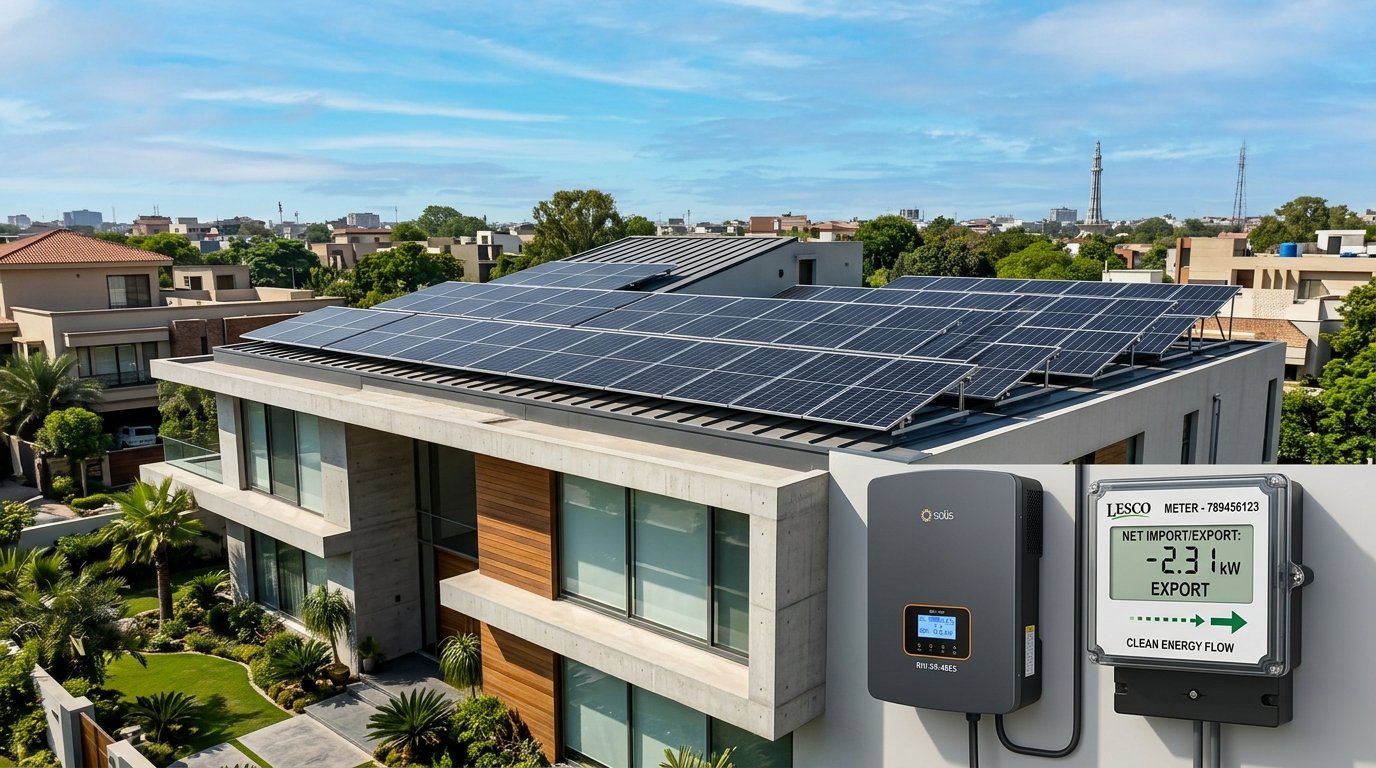
Quick Summary: The transition from net metering to net billing Pakistan 2026 marks a major regulatory shift under the updated NEPRA Prosumer Regulations 2026. While traditional net metering allowed 1:1 unit netting against high retail tariffs, net billing compensates exported units at an avoided-cost buyback rate while charging imported grid units at standard retail prices. Despite this change, is solar still worth it in Pakistan? Absolutely. By pairing rooftop solar with daytime load shifting and modern hybrid battery storage, homeowners and commercial enterprises continue to slash electricity bills by 70% to 85% with an attractive payback period of 2.5 to 3.5 years.
Pakistan’s rooftop solar landscape has grown exponentially over the past few years, driven by skyrocketing grid tariffs, fuel price adjustments (FCA), and frequent power outages. However, the anticipated regulatory shift from net metering to net billing Pakistan 2026 has triggered questions for both existing prosumers and prospective buyers planning solar installations.
If you are a homeowner, commercial property owner, or industrial facility manager, understanding how the NEPRA Prosumer Regulations 2026 operate, what the updated net billing buyback rate means for your monthly bill, and how to adapt your setup is critical. In this comprehensive guide, we unpack the policy reasons behind this shift, calculate true financial returns, address grandfathering clauses, and explain why solar remains Pakistan’s strongest hedge against escalating energy costs.
1. Quick Answer: What is Happening to Net Metering in Pakistan in 2026?
Under traditional net metering rules established by the National Electric Power Regulatory Authority (NEPRA) in 2015, grid-connected solar owners exported excess daytime units and offset them one-for-one (1:1) against high-tariff peak and off-peak grid units. Under the revised net billing framework:
- Two Separate Calculations: All units consumed from the grid (imports) are billed at the full consumer retail tariff (e.g., Rs. 45 to Rs. 65+ per kWh including taxes and surcharges).
- Wholesale Buyback Compensation: All surplus units injected into the grid (exports) are credited at a separate wholesale base generation tariff, known as the net billing buyback rate (projected around Rs. 11 to Rs. 14 per kWh).
- Self-Consumption Priority: Solar energy consumed on-site during production hours saves you the full retail price per unit immediately, making daytime self-consumption and battery storage the most profitable solar strategy.
2. What Was Net Metering and Why Has Policy Changed?
To understand the transition, we must look at how Pakistan’s grid dynamics have evolved over the last decade.
The 2015 Distributed Generation Regulations Framework
In 2015, NEPRA introduced the Alternative & Renewable Energy Distributed Generation and Net Metering Regulations. The goal was simple: incentivize private capital to install distributed renewable energy quickly to relieve severe generation deficits. For prosumers, every kilowatt-hour (kWh) pushed into the national grid canceled out a grid-consumed kWh on the electricity bill at retail value.
Why DISCOs and the Grid Pushed for Reforms
As hundreds of megawatts of distributed solar capacity came online across power distribution companies (DISCOs such as LESCO, K-Electric, IESCO, FESCO, and MEPCO), several structural grid challenges emerged:
- Capacity Charges & Circular Debt: Pakistan’s power sector carries heavy fixed capacity payment obligations to Independent Power Producers (IPPs). When high-paying commercial and affluent residential users reduce their grid consumption through net metering, fixed transmission and generation costs get distributed over remaining non-solar consumers.
- Peak Load Misalignment: Solar panels generate peak power between 11:00 AM and 3:00 PM. However, Pakistan’s grid peak demand occurs during hot summer evenings (6:00 PM to 10:30 PM) when solar output is zero. DISCOs argued that buying solar at high retail rates at noon while sustaining fossil and hydro peaking capacity at night was financially unsustainable.
- Grid Infrastructure Stability: Concentrated solar exports on local transformers (especially in urban clusters like Lahore, Islamabad, and Karachi) required feeder upgrades and voltage regulation equipment.
3. What Net Billing Means: Gross Billing vs. Net Billing Explained
Under the NEPRA Prosumer Regulations 2026, “Net Billing” is an accounting mechanism that decouples energy imports from energy exports on your utility bill.
Instead of netting kWh against kWh before applying prices, the bi-directional meter records gross imports and gross exports independently during the billing cycle:
- Gross Import Bill:
Units Imported from Grid × Applicable Retail Tariff Rate (including GST, FPA, TV fee, surcharges) - Gross Export Credit:
Units Exported to Grid × National Average Energy Generation Cost (Buyback Rate) - Net Monthly Payable:
Gross Import Bill − Gross Export Credit
| Feature | Traditional Net Metering (2015-2025) | Net Billing (2026 Framework) |
|---|---|---|
| Billing Metric | 1:1 Unit Netting (kWh against kWh) | Financial Netting (Rs. Imported vs. Rs. Exported) |
| Export Compensation | Retail consumer tariff rate (~Rs. 45–60/kWh) | Base generation / avoided cost rate (~Rs. 11–14/kWh) |
| Import Charges | Only paid on net excess units consumed | Paid on ALL units imported from grid |
| Taxes & Surcharges | Applied only to net imported units | Applied to total gross imported units |
| Optimal Strategy | Oversize solar array for maximum export | Maximize daytime self-consumption + hybrid storage |
| Financial Payback | 2.0 to 2.5 Years | 2.5 to 3.5 Years |
4. Am I Grandfathered? Existing Net Metering Contracts vs. New Applicants
One of the most urgent questions for current solar owners is: “Will my current net metering contract be cancelled immediately?”
Grandfathering Protections for Existing Distributed Generation Licenses
Under standard administrative law and NEPRA’s regulatory precedents, active Distributed Generation agreements signed between consumers and DISCOs remain protected for the duration of their contracted term (typically 3 to 7 years from issuance). If your bi-directional green meter was energized under the 2015 net metering framework, your current agreement terms are grandfathered until that specific contract expires or until system capacity expansion is requested.
What Happens When Your Existing Agreement Expires?
Upon expiry of the original 3-year or 7-year term, licence renewals will transition to the active NEPRA Prosumer Regulations 2026 net billing structure. Furthermore, any consumer applying for a brand-new connection or requesting an inverter/panel load enhancement will fall directly under the new net billing rules.
5. The New Net Billing Buyback Rate and Financial Impact
To see how the net billing buyback rate impacts a typical prosumer, let us examine a real-world mathematical comparison for a standard 10 kW rooftop solar system in Lahore or Islamabad.
System Parameters (10 kW Rooftop System)
- Monthly Solar Generation: 1,200 kWh (units)
- Household Daytime Direct Consumption: 600 kWh (50%)
- Solar Units Exported to Grid: 600 kWh (50%)
- Evening / Night Grid Consumption (Import): 700 kWh
- Grid Retail Tariff (with taxes): Rs. 55 / kWh
- Net Billing Buyback Rate: Rs. 13 / kWh
Scenario A: Under 1:1 Net Metering
- Net Units Billed: 700 units imported − 600 units exported = 100 net units.
- Monthly Bill: 100 units × Rs. 55 = Rs. 5,500.
- Monthly Savings vs. No Solar (1,300 total units = Rs. 71,500): Rs. 66,000 / month.
Scenario B: Under Net Billing (Without Changing Habits)
- Daytime Self-Consumption Savings: 600 units avoided × Rs. 55 = Rs. 33,000.
- Gross Import Bill: 700 units × Rs. 55 = Rs. 38,500.
- Export Credit: 600 units exported × Rs. 13 = Rs. 7,800.
- Net Monthly Bill: Rs. 38,500 − Rs. 7,800 = Rs. 30,700.
- Monthly Savings vs. No Solar: Rs. 71,500 − Rs. 30,700 = Rs. 40,800 / month.
Notice the critical takeaway: Even without adding batteries or adjusting appliances, the 10 kW system still saves over Rs. 40,000 every month! When optimized with hybrid storage, savings jump right back above Rs. 60,000+ monthly. To calculate your personalized payback figures, use our interactive tool to calculate your solar ROI.
6. Is Solar Still Worth It in Pakistan Under Net Billing?
The short answer is an unequivocal YES. Here is why the question “is solar still worth it in Pakistan?” has a resounding positive outcome:
- Self-Generated Electricity Costs Only ~Rs. 6–8 / kWh: When you levelize the capital cost of a Tier-1 solar installation over its 25-year lifespan, your cost of self-generated electricity is roughly Rs. 6 to Rs. 8 per unit. Comparing that to DISCO grid power at Rs. 50 to Rs. 70 per unit delivers an instant 85%+ discount on every unit consumed on-site.
- Continuous Grid Tariff Escalation: IMF reforms, fuel import costs, and currency depreciation mean grid power tariffs in Pakistan will continue upward. Solar locks in your energy generation cost for the next 25 years.
- High Commercial Feasibility: Commercial buildings, hospitals, schools, and retail outlets operate primarily during sunlight hours (8:00 AM to 6:00 PM). For these facilities, self-consumption is naturally 80% to 95%, meaning net billing has almost negligible impact on their high ROI. Read our specialized breakdown on commercial solar systems for businesses.
- Global Solar Equipment Prices at Historic Lows: High-efficiency TOPCon N-type monocrystalline panels and smart inverters are more affordable today than in previous years, keeping capital expenditure low and shortening payback windows.
7. Adapting Your Solar Strategy: Hybrid Inverters and Battery Storage
The transition from net metering to net billing Pakistan 2026 fundamentally changes the game from “maximize grid exports” to “maximize on-site self-consumption.” Here is how smart prosumers are staying ahead:
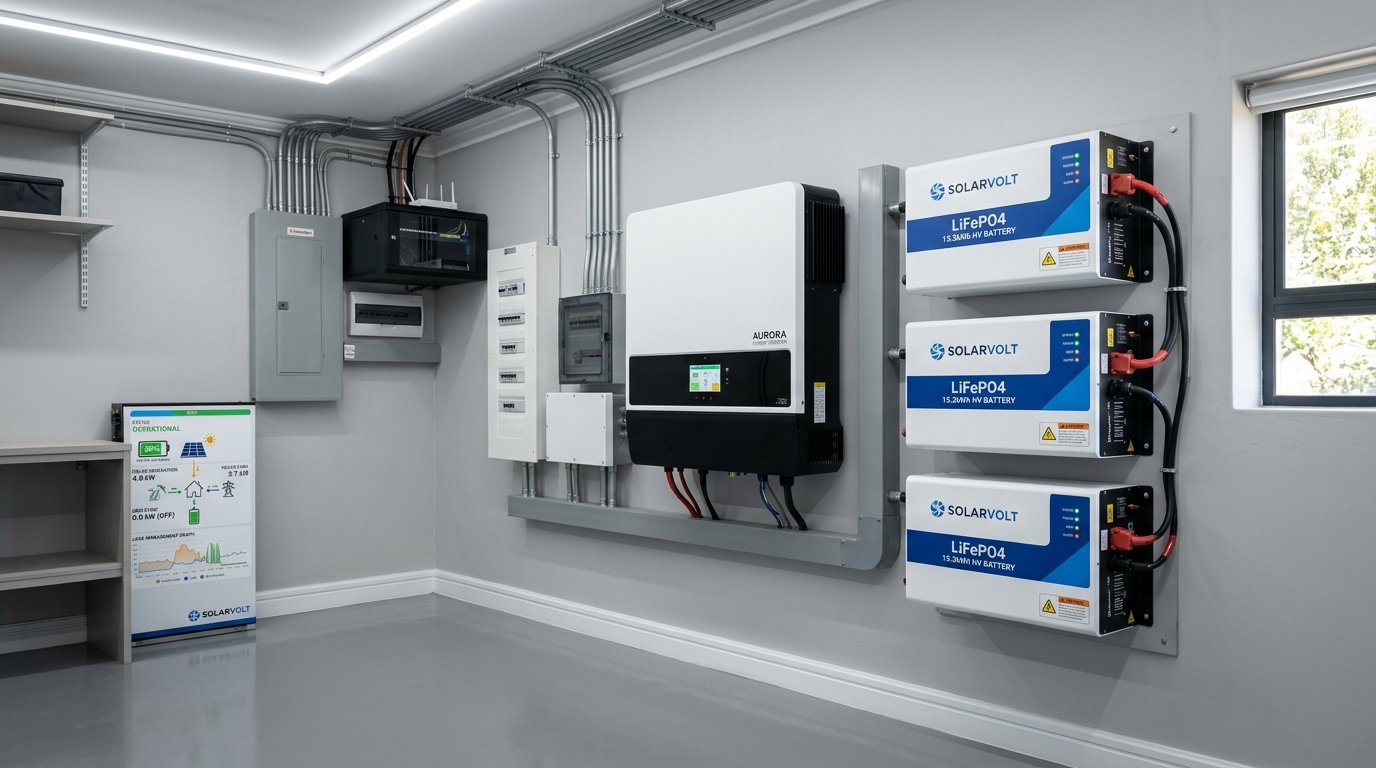
A. Switch to Hybrid Inverters with Energy Storage
Instead of dumping surplus midday solar power to the grid at Rs. 12–14/kWh and later buying nighttime power at Rs. 55/kWh, hybrid systems store that excess energy in high-cycle Lithium Iron Phosphate (LiFePO4) batteries. During the expensive evening peak hours (6 PM to 10 PM), your home runs completely off stored solar energy, entirely avoiding peak utility charges.
Learn more about sizing and cost tradeoffs in our detailed guide on solar battery storage options during load shedding.
B. Smart Day-Time Load Shifting
Shift energy-heavy household and industrial tasks to solar peak hours (10:00 AM – 3:30 PM):
- Run agricultural tube wells and water motors during peak sunshine.
- Schedule electric vehicle (EV) charging and home inverter ACs between 11:00 AM and 3:00 PM.
- Run laundry machines, dishwashers, and water heaters on solar direct power.
C. Proper System Sizing and Maintenance
Avoid oversized on-grid arrays that generate massive unused export surpluses. Instead, right-size your solar panel capacity to match your realistic load profile. Discover the exact calculations in our guide on how many solar panels you need, and ensure optimal generation through regular cleaning by reading our guide on cleaning solar panels in Lahore.
8. Frequently Asked Questions (FAQ)
Will DISCOs replace my existing green net meter?
No. Standard bi-directional green meters installed for net metering already record both imported and exported kWh separately. Transitioning to net billing only requires a software/billing algorithm update at the distribution company’s billing center, not a physical meter replacement at your premises.
Under NEPRA Prosumer Regulations 2026, can I still sell surplus solar to the grid?
Yes, you can still export surplus energy to the grid. The difference is the financial compensation rate: exported units are credited at the wholesale generation cost (buyback rate) rather than the retail tariff.
What is the estimated net billing buyback rate in Pakistan for 2026?
The estimated buyback rate is expected to sit between Rs. 11.00 and Rs. 14.50 per kWh, reflecting the national average power generation cost determined periodically by NEPRA.
Is solar still worth it in Pakistan without battery storage?
Yes. On-grid solar without batteries continues to wipe out 100% of your daytime electricity costs. Since commercial establishments and many homes operate air conditioners and appliances throughout the day, daytime bill reduction alone yields a payback period of approximately 2.5 to 3 years.
How does EXPO Solar help homeowners transition to high self-consumption hybrid setups?
At EXPO Solar Pakistan, our engineering team designs custom hybrid and on-grid solar solutions tailored specifically to the latest NEPRA guidelines. We configure Tier-1 Tier-A Tier-Plus solar panels, smart hybrid inverters (including Knox, GoodWe, Solis, and Inverex), and durable LiFePO4 batteries to maximize your energy independence and protect your investment against future regulatory revisions.
Final Takeaway: Take Control of Your Energy Future
The shift from net metering to net billing Pakistan 2026 reflects a maturing solar market. While the era of treating the national utility grid as an unlimited free storage battery is transitioning, rooftop solar remains the single most effective financial investment for Pakistani property owners to defend against inflationary power tariffs.
Ready to audit your rooftop solar potential, upgrade to a smart hybrid system, or secure your net metering license before policy deadlines? Contact the certified solar engineers at EXPO Solar Pakistan today for a free site assessment and comprehensive ROI analysis.

Best Solar Battery For Home Use In Pakistan (2026): Lithium Vs Lead-Acid
August 14, 2026 9:14 pm[…] August 14, 2026 […]
Solar Panel Financing In Pakistan: 2026 Bank Guide
October 9, 2026 5:18 am[…] the system for self-consumption. Under 2026’s net billing rules, exported units earn only about Rs 11 while imported units cost up to Rs 50. Financing an oversized […]