



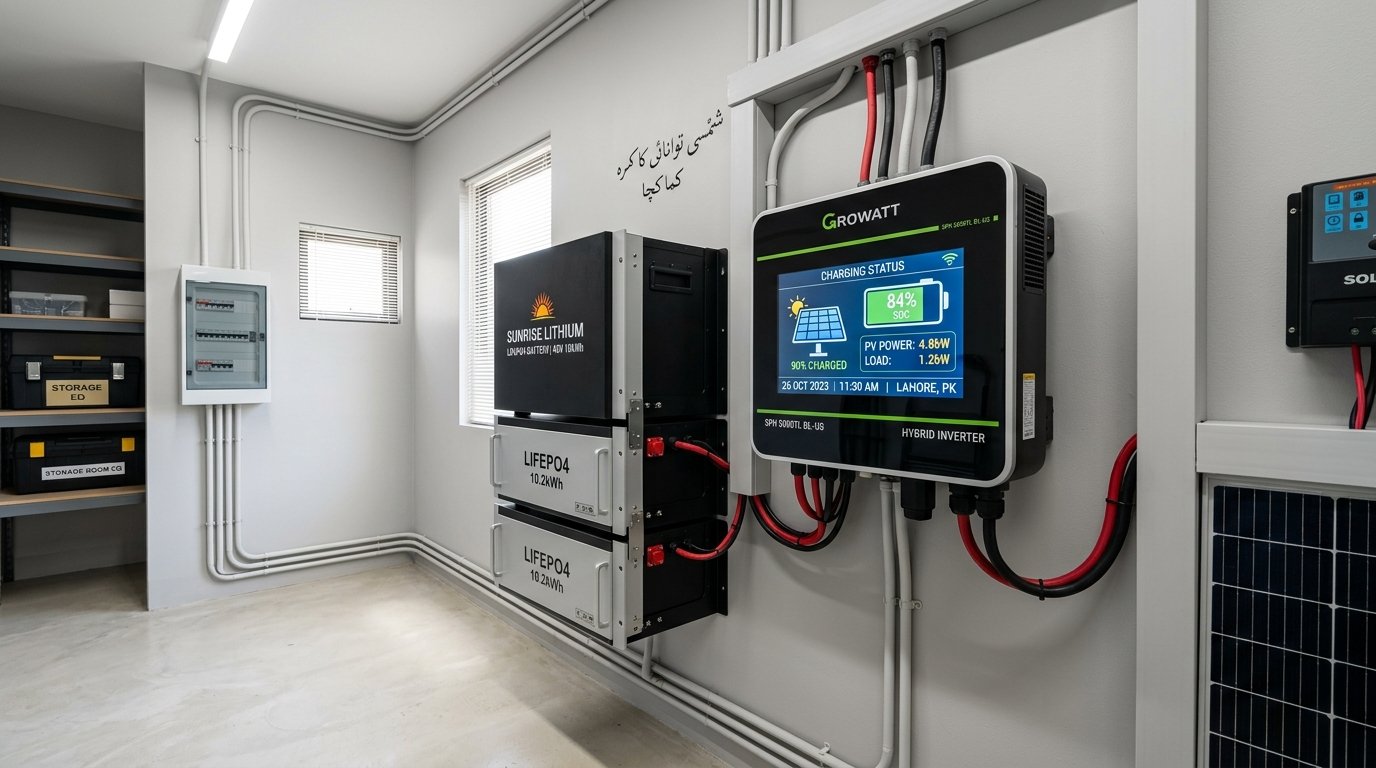
Quick 2026 Verdict: For Pakistani homeowners installing a 5kW to 10kW hybrid solar system, Lithium Iron Phosphate (LiFePO4) is the undisputed best solar battery. While its upfront cost is 2× to 2.5× higher than tubular lead-acid, its 10+ year lifespan (6,000 cycles at 90% DoD), zero maintenance, and 95% round-trip efficiency deliver a 40% lower 10-year Total Cost of Ownership (TCO). Tubular batteries remain practical only for budget-constrained installations with minimal nighttime load.
With grid electricity tariffs exceeding Rs. 65–75 per peak unit and NEPRA transitioning from Net Metering to Net Billing in 2026, choosing the best solar battery in Pakistan is no longer just about surviving load shedding. It is now the single most important factor determining your monthly electricity bill savings.
When DISCOs buy back your daytime surplus solar energy at only Rs. 14–16 per unit but charge you Rs. 60+ to draw power at night, storing your solar energy for evening self-consumption beats exporting it to the grid every single day. But should you invest in modern Lithium (LiFePO4) batteries or stick with traditional Tubular Lead-Acid batteries? Let’s break down the real numbers for the Pakistan market.
1. Lithium vs Lead-Acid Battery Comparison: Complete Specs & Cost in Pakistan
Here is an objective, head-to-head comparison between Lithium Iron Phosphate (LiFePO4) wall-mounted batteries and deep-cycle Tall Tubular lead-acid batteries in 2026:
| Feature / Metric | Lithium (LiFePO4) Battery | Tall Tubular Lead-Acid Battery |
|---|---|---|
| Initial Upfront Cost (5 kWh capacity) | Rs. 280,000 – Rs. 360,000 | Rs. 130,000 – Rs. 160,000 (4 × 12V 200Ah) |
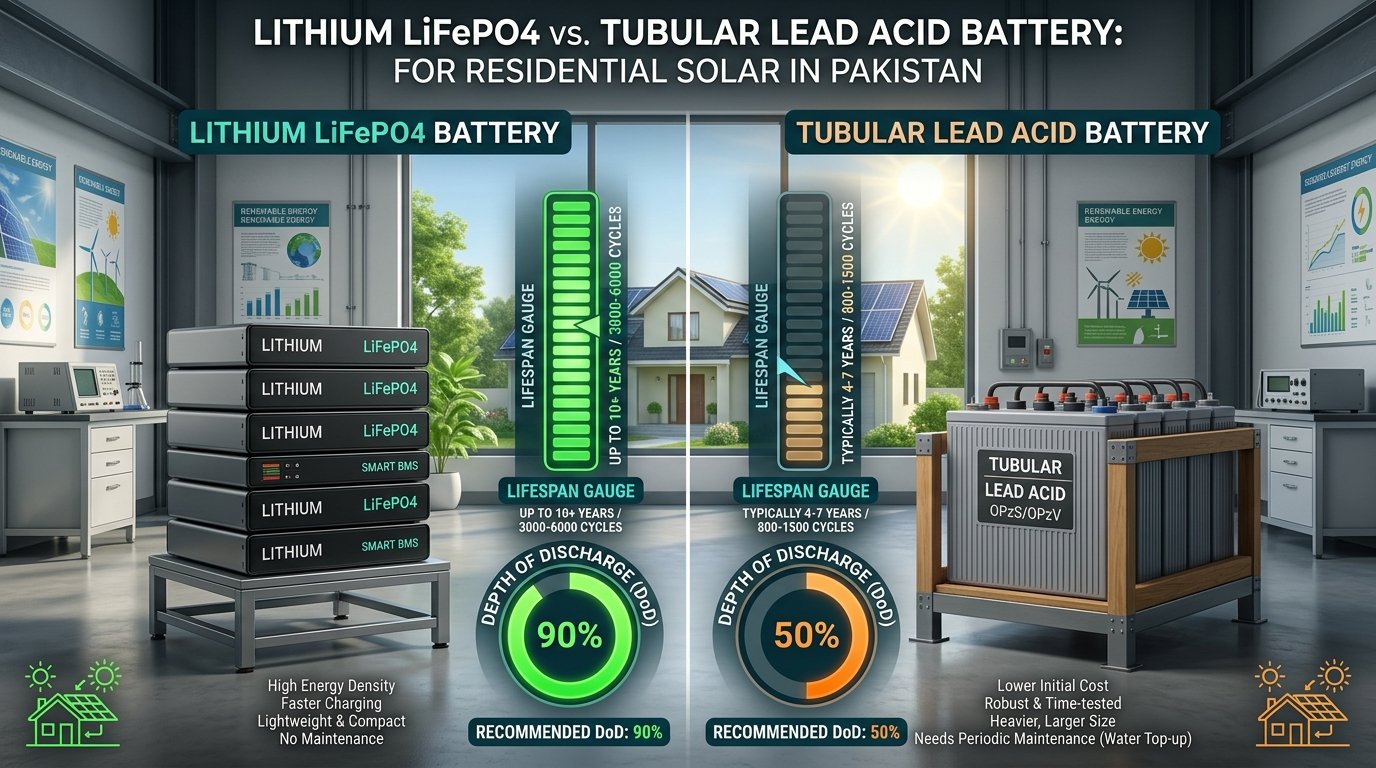
| Cycle Life (to 80% capacity) | 4,000 – 6,000 cycles | 1,000 – 1,500 cycles |
| Expected Lifespan | 10 to 15 Years | 3 to 4 Years |
| Usable Depth of Discharge (DoD) | 90% – 95% | 50% (Max safe discharge) |
| Round-Trip Efficiency | 95% – 98% | 75% – 80% (20%+ lost as heat) |
| Maintenance Required | Zero maintenance (Smart BMS) | Monthly distilled water top-up + acid check |
| Space & Weight | Compact, wall-mounted (~45–55 kg) | Bulky rack, heavy (~240–280 kg total) |
| Hazardous Fumes & Odors | Zero emission (Safe for indoor installation) | Emits hydrogen gas & acid fumes during charging |
| Warranty in Pakistan | 5 to 10 Years standard | 1 to 2 Years |
| 10-Year Total Replacements | 0 replacements needed | 2 to 3 full bank replacements |
| 10-Year Total Cost of Ownership | Rs. 320,000 (Lower) | Rs. 480,000 – 550,000 (Higher) |
2. Why Solar Batteries Matter More in 2026 (The Net Billing Revolution)
Under Pakistan’s previous 1:1 net metering framework, the national electrical grid acted as a free virtual battery. You could export 1 unit during the blazing afternoon and withdraw 1 unit at night with zero loss. That era has officially ended.
Under NEPRA’s revised Net Billing Prosumer Regulations (read our detailed breakdown on Net Metering to Net Billing in Pakistan):
- Export Buyback Rate: DISCOs (LESCO, K-Electric, IESCO) credit your daytime surplus at the national average power purchase price (approx. Rs. 14.50 – 16.50/unit).
- Import Peak Tariff: When you draw power between 6:00 PM and 11:00 PM to run inverter ACs, fans, and refrigeration, you are billed at peak consumer rates (Rs. 62.00 to Rs. 78.00/unit including fuel adjustment charges and taxes).
- The Financial Gap: For every kilowatt-hour you export and buy back, you lose Rs. 48 to Rs. 60 per unit in tariff spread.
By routing daytime solar generation into a high-efficiency Lithium LiFePO4 battery bank, you avoid purchasing expensive peak grid power completely, accelerating your overall solar system ROI.
3. Lithium (LiFePO4) Solar Batteries: Pros, Cons & Best Brands in Pakistan
Lithium Iron Phosphate (LiFePO4) chemistry is specifically tailored for Pakistan’s harsh environmental conditions because it possesses high thermal stability and cannot enter thermal runaway (unlike older Lithium-Cobalt phone batteries).
Top Advantages of Lithium Batteries:
- 90%+ Usable Energy: A 10 kWh lithium pack delivers 9.0–9.5 kWh of actual usable energy without damaging the cell structure.
- Rapid Charging: Lithium accepts high charge currents (0.5C to 1C), recharging from 0% to 100% in just 2 to 2.5 hours of bright sunlight.
- Integrated Smart BMS: Built-in Battery Management System (BMS) communicates directly with hybrid inverters (via CAN/RS485) to protect against over-discharge, high ambient temperature, and cell imbalance.
- Zero Daily Maintenance: No water topping, no corrosive terminal cleaning, and completely sealed for indoor bedroom or garage installation.
Leading Lithium Battery Brands in Pakistan:
- Huawei LUNA2000 (5kWh – 15kWh modular): The gold standard in residential energy storage with 100% DoD and 10-year warranty.
- Narada 48V 100Ah / 200Ah Lithium: Highly popular, reliable telecommunication-grade LiFePO4 cells offering 5,000+ cycles.
- Pylontech US3000C / US5000: Globally certified, modular rack-mount batteries compatible with Growatt, Deye, and Voltronic inverters.
- Inverex Power Wall & LiFePO4: Locally distributed with authorized service centers across Lahore, Karachi, and Islamabad.
- Felicity Solar / Dyness: Cost-effective wall-mounted solutions offering high-density storage for 5kW–10kW systems.
4. Tubular Lead-Acid Batteries: Are They Still Worth It?
Tall Tubular batteries (like Phoenix TX-1800/2500, AGS, Osaka, and Daewoo) utilize thick lead oxide plates encased in woven tubes. While they are significantly better than standard automotive car batteries, they have critical limitations in a 2026 solar setup:
- The 50% DoD Constraint: If you buy a bank rated for 10 kWh, you can only safely discharge 5 kWh. Discharging deeper than 50% permanently damages the lead plates and voids your warranty.
- High Internal Resistance & Heat Loss: Up to 20–25% of your expensive solar power is wasted as heat during charging.
- Maintenance Burden: In hot Pakistani summers (May–July), electrolyte evaporation requires regular distilled water refilling every 3 to 4 weeks.
- When They Still Make Sense: If your total budget is under Rs. 150,000 and you only need basic 2–3 hour backup for fans and LED lights during outages, a 2-battery or 4-battery tubular bank remains a viable entry-level option.
5. How to Size Your Solar Battery Bank for Evening Loads
To calculate the exact battery capacity your home requires from sunset (6:30 PM) until bedtime (11:30 PM), use this engineering sizing formula:
Required Battery Capacity (kWh) = (Total Connected Watts × Operating Hours) ÷ (DoD × Inverter Efficiency)
Real-World Sizing Example (Typical Pakistani 10-Marla / 1-Kanal Home):
| Appliance | Wattage (Running) | Evening Hours | Total Daily Consumption |
|---|---|---|---|
| 1 × 1.5-Ton DC Inverter AC | 1,000 Watts (avg) | 5 Hours | 5.00 kWh |
| 4 × BLDC Energy Saver Fans | 40 Watts each = 160W | 6 Hours | 0.96 kWh |
| 10 × LED Lights | 12 Watts each = 120W | 6 Hours | 0.72 kWh |
| 1 × Inverter Refrigerator | 150 Watts | 6 Hours (50% duty) | 0.45 kWh |
| Wi-Fi Router + LED TV | 120 Watts | 5 Hours | 0.60 kWh |
| Total Evening Energy Requirement | – | – | 7.73 kWh |
- If Using Lithium LiFePO4 (90% DoD): You need
7.73 kWh ÷ 0.90 = 8.6 kWh. A standard 10 kWh 48V 200Ah Lithium Pack easily handles this entire night load with capacity to spare. - If Using Tubular Lead-Acid (50% DoD): You need
7.73 kWh ÷ 0.50 = 15.5 kWhof raw battery capacity. That requires 8 heavy 12V 200Ah tubular batteries, taking up massive floor space and requiring periodic water maintenance.
Explore today’s live pricing on Tier-1 panels to charge your storage bank in our Solar Panel Price in Pakistan (Daily Live Rates) guide.
6. Frequently Asked Questions (FAQ)
How much does a 5kWh lithium battery cost in Pakistan in 2026?
A high-quality 5kWh 48V 100Ah Lithium LiFePO4 battery (Narada, Pylontech, Inverex, Felicity) costs between Rs. 260,000 and Rs. 330,000 in Pakistan, depending on the brand, BMS features, and warranty duration.
Can I run a 1.5-ton AC on a solar lithium battery?
Yes. A 1.5-ton DC inverter AC consumes approximately 1.0 to 1.2 kW per hour once the room cools down. A 10kWh lithium battery bank can easily run your 1.5-ton AC for 7 to 9 continuous hours at night.
Can I mix lithium batteries with existing tubular batteries?
No, never mix different chemistries. Lithium and lead-acid batteries have fundamentally different charge voltages, internal resistances, and charging algorithms. Connecting them together will destroy the lead-acid cells and trigger BMS faults on the lithium pack.
How many years does a LiFePO4 battery actually last in Pakistan’s summer heat?
Under daily cycling (1 charge and 1 discharge per day = 365 cycles/year), a 6,000-cycle LiFePO4 battery lasts over 12 to 15 years before reaching 80% remaining capacity, even in ambient summer temperatures up to 45°C.
Get Custom Hybrid Battery Storage Sizing from EXPO Solar
Ready to upgrade your home to true energy independence and eliminate peak electricity bills? Contact EXPO Solar Pakistan for expert hybrid system engineering, Tier-1 LiFePO4 battery installations, and customized energy audits across Lahore, Islamabad, Karachi, and Okara.

Solar Panel Price In Pakistan: October 2026 Guide
October 6, 2026 7:14 am[…] sized to your daytime load pays back years faster than an oversized one built for export. Our battery guide explains how storage fits into this […]
Solar Panel Financing In Pakistan: 2026 Bank Guide
October 9, 2026 5:19 am[…] amount. Worth it if outages hit your work or sleep; less so if your area has stable supply. Our battery comparison breaks down lithium vs lead-acid […]