



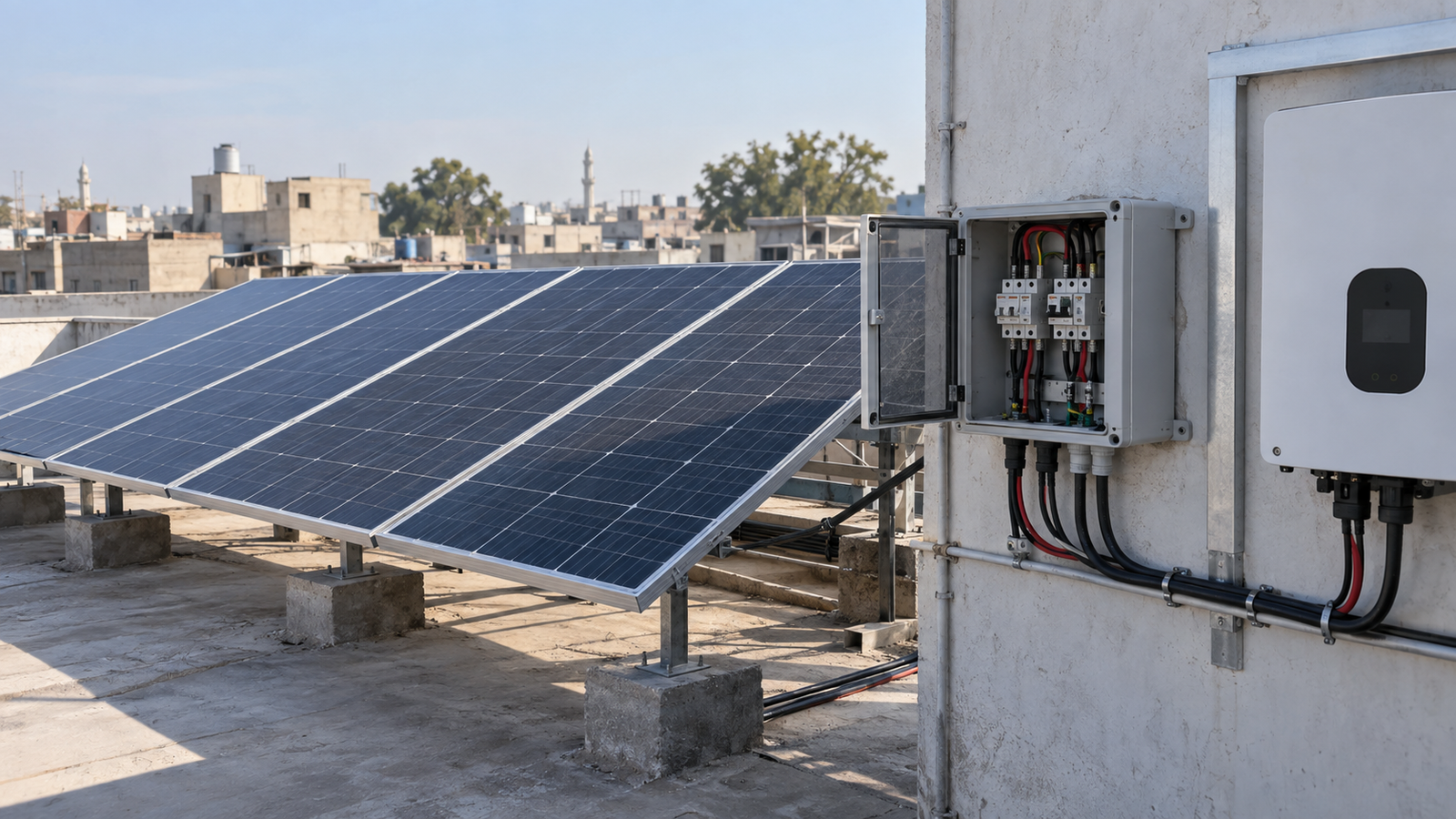
When people search for a 500V DC breaker, they are usually looking for a specific type of protection device for a solar or other DC electrical circuit. The important detail is not simply “500V.” A breaker has to match the circuit’s DC voltage, current, fault conditions, wiring, and the equipment manufacturer’s requirements.
For Pakistani solar installations, a 2-pole 500V DC MCB is one configuration used for lower-voltage PV strings and other DC circuits. EXPO Solar’s current protection category lists a 2P 500V DC MCB at Rs. 2,400, although prices can change with product specification and market conditions.
The key point is simple: do not choose a 500V breaker just because your solar panels are “around 500V.” The complete string design has to stay within the breaker’s specified DC rating under the relevant operating conditions.
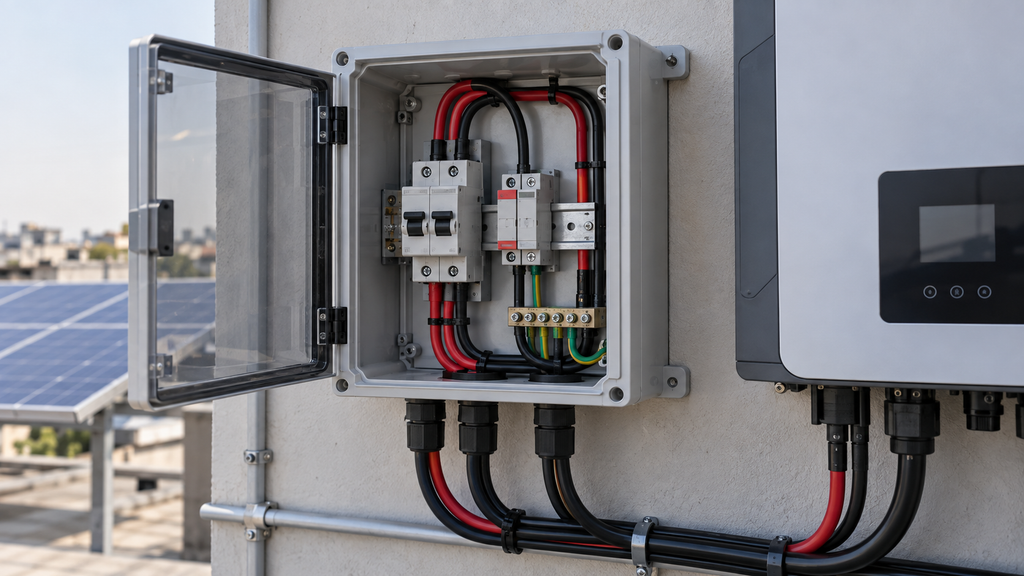
What Is a 500V DC Breaker?
A 500V DC breaker is a circuit breaker specifically rated to interrupt direct current at voltages up to its specified DC operating rating.
Its job can include:
- disconnecting a DC circuit
- interrupting an overload
- interrupting a short-circuit fault
- providing a resettable means of protection in systems designed for that breaker
The “DC” part matters.
Direct current behaves differently from alternating current when a circuit opens. An AC waveform repeatedly passes through zero current, which helps an arc extinguish. A DC circuit does not have the same natural zero crossing, so a breaker designed for DC service needs an appropriate arc-extinguishing design and DC voltage rating.
That is why an ordinary AC MCB should not automatically be substituted for a DC-rated breaker.
CHINT’s official NB1-63DC documentation, for example, specifies the series for DC circuits and gives 1-pole, 2-pole and 4-pole voltage configurations of 250V, 500V and 1000V DC respectively.
What Does “500V” Actually Mean?
The 500V figure is the breaker’s rated DC operating voltage for the specified pole configuration.
For a 2-pole DC breaker, the manufacturer may specify something such as:
| Specification | Example |
|---|---|
| Pole configuration | 2P |
| Rated DC voltage | 500V DC |
| Rated current | Model-dependent |
| Breaking capacity | Model-dependent |
| Mounting | Often DIN rail |
| Standard | Manufacturer/model dependent |
For example, CHINT’s NB1-63DC documentation specifies 2P at DC 500V, current ratings up to 63A, and a rated ultimate short-circuit capacity of 6kA.
These numbers are properties of that particular product family. They should not be assumed for every 500V DC breaker sold in Pakistan.
Where Is a 500V DC Breaker Used in Solar Systems?
A 500V DC breaker can be used on a compatible photovoltaic string or other DC circuit where the system’s maximum voltage and current fall within the device’s specifications.
A typical arrangement can look like:
Solar panels → DC protection/disconnect equipment → inverter
The actual arrangement depends on the inverter, string configuration, combiner-box design, protection scheme, and applicable installation requirements.
A 2025 Punjab Vocational Training Council tender provides a real Pakistani example: its specification included a 500V 2-pole DC breaker rated at 16/10A with a 6kA short-circuit rating for a solar-related installation.
That demonstrates that the 500V/2P configuration is not merely an online product-search term; it is also found in practical electrical procurement specifications in Pakistan.
Why You Should Not Use an AC Breaker on a DC Solar Circuit
This is one of the most important distinctions when selecting protection equipment.
An AC MCB and a DC MCB may look similar from the outside, but their electrical ratings and interruption capability are not interchangeable.
For a DC circuit, the breaker must be designed and rated to interrupt the relevant DC voltage and fault current. Schneider Electric’s documentation for DC circuit breakers identifies IEC 60947-2 as the applicable circuit-breaker product standard and describes dedicated arrangements for photovoltaic DC applications.
So a breaker marked only for 230V/400V AC should not be treated as a 500V DC breaker.
Before installation, check the actual markings and the manufacturer’s datasheet.
How Do You Select the Correct 500V DC Breaker?
There are several ratings to check. Voltage and current are not interchangeable.
1. Check the maximum DC voltage
This is the first filter.
If the circuit can exceed the breaker’s rated DC voltage, that breaker is not an appropriate choice for the circuit.
For a PV string, the voltage is affected by the number of modules connected in series and the electrical characteristics of the modules. Module open-circuit voltage also changes with temperature, so a proper design should consider the maximum expected string voltage rather than relying only on a nominal value written on the panel.
This is why “the panels normally produce 450V” is not enough information to approve a 500V breaker.
2. Check the current rating
After establishing the voltage requirement, select the appropriate current rating based on the circuit design.
The breaker current rating must be considered alongside:
- module short-circuit current
- number of parallel strings
- cable ampacity
- installation conditions
- ambient temperature
- inverter manufacturer’s requirements
- applicable protection rules
A bigger ampere rating is not automatically safer.
Oversizing a protective device can reduce its ability to protect the conductors during a fault, while undersizing can result in unnecessary tripping.
3. Check the number of poles
A 500V DC breaker is not automatically a 2-pole device.
The number of poles is part of the product’s voltage configuration. For the CHINT NB1-63DC series, for example, the manufacturer’s documentation specifies 250V DC for 1P, 500V DC for 2P, and 1000V DC for 4P.
The required pole configuration must therefore be selected from the system design and the exact manufacturer’s instructions.
4. Check the breaking capacity
The breaker also needs an adequate short-circuit breaking capacity.
For example, the CHINT NB1-63DC documentation specifies an ultimate short-circuit capacity of 6,000A for that series.
Do not assume that every breaker advertised as “500V DC” has the same breaking capacity.
5. Check polarity and installation instructions
Some DC breakers are polarized, and the manufacturer may specify particular terminal polarity and wiring arrangements.
The correct installation therefore requires more than simply snapping a breaker onto a DIN rail.
Follow the exact product datasheet and wiring diagram.
500V DC Breaker vs DC Isolator vs DC Fuse vs DC SPD
These devices do different jobs.
| Device | Main purpose |
|---|---|
| DC breaker | Overcurrent protection and switching/isolation functions depending on design |
| DC isolator | Safe manual disconnection; not automatically an overcurrent-protection device |
| DC fuse | Overcurrent protection using a replaceable fuse element |
| DC SPD | Surge protection against transient overvoltage |
They are complementary components in a protection system, not interchangeable names for the same device.
For example, replacing a DC SPD with a breaker does not provide the same surge-protection function.
Likewise, using an isolator does not automatically provide the same overload/short-circuit protection as a circuit breaker.
500V DC Breaker Price in Pakistan
EXPO Solar’s current protection-products category lists a 2P 500V DC MCB at Rs. 2,400.
The same page also lists other DC protection products, including a CNC 2-pole 500V DC miniature circuit breaker at Rs. 2,500 and a separate 2-pole 125A DC breaker for battery applications at Rs. 1,999. These products should not be treated as interchangeable simply because they are all DC breakers; their intended applications and ratings differ.
As a market reference, another Pakistani supplier currently lists a CNC YCB8-63PV 2-pole 500V solar DC MCB in several current ratings and shows Rs. 1,600 on its product page.
This illustrates why there is no single universal “500V DC breaker price in Pakistan.” The final price depends on the manufacturer, ampere rating, pole configuration, product family, certification, and seller.
For buying decisions, compare the complete specification rather than selecting the cheapest device with “500V” printed on it.
Example: Why Panel Count Matters
Suppose a solar module has a nominal open-circuit voltage around 40V.
Ten modules connected in series would have a nominal string open-circuit voltage of approximately:
40V × 10 = 400V
That does not automatically mean a 500V breaker is suitable.
The actual design also has to account for the module’s specified electrical characteristics and temperature effects. The relevant design voltage can therefore be higher than the simple nominal calculation.
This example is illustrative, not an engineering design.
Common Mistakes When Buying a 500V DC Breaker
One common mistake is selecting the breaker based only on amperage. A 32A breaker that is correctly rated for current can still be unsuitable if its DC voltage rating is too low.
Another mistake is using an AC breaker because its physical dimensions look similar.
A third mistake is assuming that “500V” alone tells you whether the product is suitable for solar PV. You still need to verify current rating, breaking capacity, pole configuration, polarity, intended application, and manufacturer instructions.
Another frequent problem is choosing a battery breaker for a PV-string application or treating a PV-string breaker as a generic high-current battery disconnect. The devices can have materially different specifications and use cases.
Is a 500V DC Breaker Suitable for Every Solar System?
No.
A 500V DC breaker is suitable only where the circuit’s electrical requirements are within the device’s specified ratings.
Many modern solar systems use higher-voltage strings. The appropriate breaker may therefore need a higher DC voltage rating or a different pole configuration.
For example, CHINT’s own documentation uses 2P at 500V DC and 4P at 1000V DC within the same breaker family.
Schneider Electric’s photovoltaic DC documentation also shows that pole arrangement becomes particularly important in higher-voltage DC applications.
The correct question is therefore not:
“Is a 500V breaker good for solar?”
It is:
“Does this exact breaker meet the voltage, current, interruption, polarity, and application requirements of my solar circuit?”
What Should You Check Before Buying?
Before purchasing a 500V DC breaker, verify the following from the actual product label and datasheet:
- DC voltage rating
- Rated current
- Number of poles
- DC short-circuit breaking capacity
- Polarity requirements
- Applicable standard
- PV-specific suitability, where required
- Manufacturer and exact model
- Compatibility with the inverter and protection scheme
- Cable and system design
Do not rely on the seller’s product title alone.
A product title saying “500V Solar Breaker” is not enough evidence of suitability for a particular PV installation.
EXPO Solar’s 500V DC Breaker Listing
EXPO Solar currently lists a 2P 500V DC MCB under its Protection & Tools category at Rs. 2,400. The company presents this category as supplying solar protection components and related electrical tools in Pakistan.
For an actual installation, however, the correct model and current rating should be selected according to the system design rather than simply choosing the product appearing first in a search result.
Related EXPO Solar pages for DC protection, solar inverters, and other system components can be linked here where those pages are genuinely relevant.
Conclusion
A 500V DC breaker is a specific electrical protection device, not simply a larger version of a household AC breaker.
For solar applications, selection should start with the system’s maximum DC voltage and current, then move to pole configuration, breaking capacity, polarity, application type, and manufacturer requirements.
EXPO Solar currently lists a 2P 500V DC MCB at Rs. 2,400, but the correct breaker for a particular installation should always be determined from the actual system design and the manufacturer’s technical documentation.
